Most merchants focus on which payment processor or gateway they use. But whether a card payment is approved often depends on something less visible: which acquirer it is sent through. BIN routing uses the first digits of a card number to send each payment along the route most likely to succeed.
This guide explains what a BIN is, how BIN routing works, when it helps, what it needs, and how it fits with payment orchestration.
Key takeaways
- A BIN (bank identification number) is the first 6 to 8 digits of a card number. It identifies the issuer, card brand, card type and issuing country.
- BIN routing sends each payment to the acquirer or route that performs best for that kind of card.
- It only works if you have more than one acquirer or route, and enough volume to compare their results.
- The main gains come from local acquiring, matching cards to acquirers with better approval results, and lower cross-border costs.
- BIN routing is one of the tools inside payment orchestration, alongside retries and failover.
What is a BIN?
A BIN, also called an issuer identification number (IIN), is the first part of a card number. Under the ISO/IEC 7812 standard, card schemes have moved from 6-digit to 8-digit BINs, so both lengths are in use. A BIN tells you:
- the issuing bank;
- the card brand, such as Visa or Mastercard;
- the card type, such as debit, credit, prepaid or commercial;
- the issuing country.
That information is available the moment the customer enters their card number, before the payment is sent for authorisation, which is what makes routing decisions possible.
What is BIN routing?
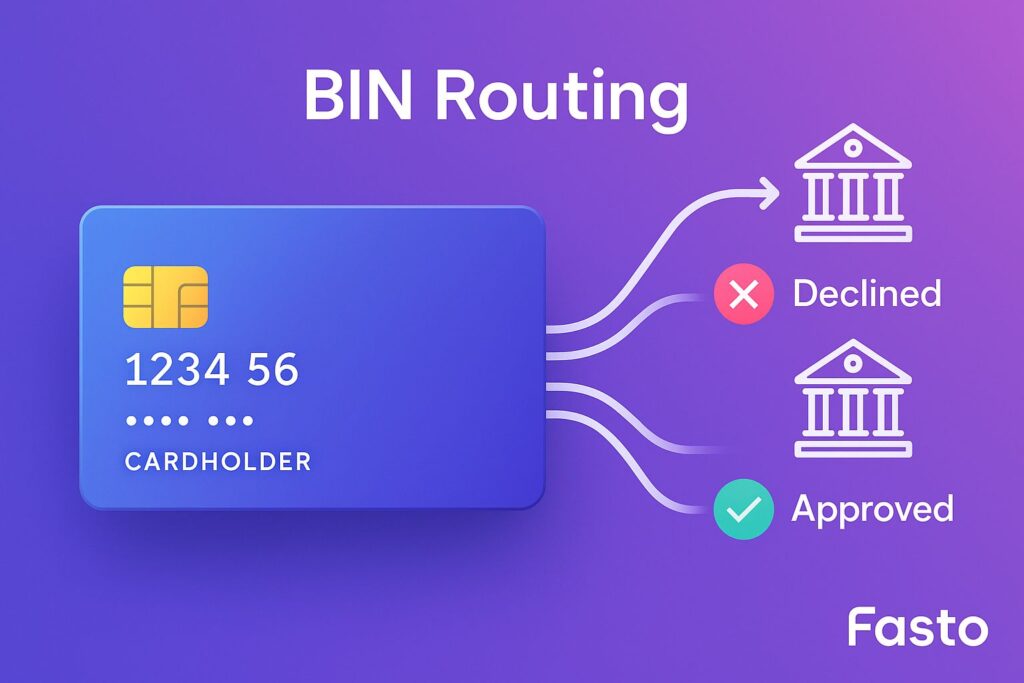
BIN routing means using the card’s BIN to decide where to send the payment. If you have several acquirers, the gateway or orchestration layer reads the BIN and picks the route with the best expected result for that card, based on rules or on your own performance data.
A simple example: a merchant with acquirers in the EU and the UK sends cards issued in the EEA to the EU acquirer and cards issued in the UK to the UK acquirer. Each payment is then processed domestically for the issuer, which is usually treated as lower risk and costs less than a cross-border transaction.
How BIN routing works, step by step
- The customer enters their card details at checkout.
- The gateway looks up the BIN: issuer, country, brand and card type.
- Routing rules decide which acquirer or route to use, for example by issuing country, card type or historical approval rate.
- The payment is sent for authorisation along that route.
- The result is recorded, so the rules can be improved over time.
This all happens in the time it takes to authorise a normal payment.
Why BIN routing matters
Higher approval rates
Issuers tend to approve more readily when the acquirer is in the same country or region, and some acquirers simply perform better with certain issuers or card types. Routing each card to the route that performs best for it can lift your overall approval rate. How much depends on your card mix and your acquirers, so measure it rather than assume it.
Lower costs
Processing a card through an acquirer in the same region avoids cross-border scheme fees and, for consumer cards issued in the EEA, keeps interchange within the EU’s caps. Routing also lets you send card types with different costs to the acquirer that prices them best.
Resilience
With more than one route available, you can move traffic away from an acquirer that is having problems, so a single outage doesn’t stop your sales.
Better data
Comparing results by BIN, country and card type shows where declines really come from, which helps with the rest of your approval rate work.
What BIN routing needs
- More than one acquirer or route. With a single acquirer, there is nothing to route between.
- Enough volume. You need enough transactions per country or card type to see which route performs better.
- A gateway or orchestration layer that can apply routing rules and report results.
- Acquirers that accept your business. For high-risk merchants, every route must be approved for your merchant category, and each acquirer will underwrite you separately.
- Consistent descriptors and data across routes, so customers recognise every charge.
Co-badged cards in the EU
Some cards in the EU carry two brands, such as a national debit scheme and an international one. Under the EU’s Interchange Fee Regulation, merchants can set which brand is used by default for co-badged cards, while the customer can still choose another. Routing co-badged cards to the cheaper brand is a form of routing that can reduce costs in markets where these cards are common.
BIN routing in high-risk industries
High-risk merchants often see more declines, because issuers are cautious with merchant categories such as adult, gambling and nutraceuticals. BIN routing doesn’t change how issuers see your category, but it helps you make the most of the routes you have: processing locally where possible, keeping traffic with acquirers that perform well for your card mix, and having a backup when one route has problems.
It also comes with responsibilities. Card schemes monitor fraud and disputes at merchant and acquirer level, for example under Visa VAMP. Routing is for performance and resilience, never for spreading traffic to keep a high dispute ratio out of sight. That kind of splitting breaks scheme rules.
BIN routing and payment orchestration
BIN routing is one part of a wider approach. Payment orchestration combines routing rules with retries, failover and payment method selection across several providers. If you only need simple country-based routing, your gateway may handle it. If you work with several acquirers and payment methods, orchestration gives you more control. Our guides to payment gateways and payment service providers explain how the pieces fit together.
Frequently asked questions
What does BIN stand for?
BIN stands for bank identification number. It is the first 6 to 8 digits of a card number and identifies the issuer, card brand, card type and issuing country.
What is BIN routing?
BIN routing uses the card’s BIN to decide which acquirer or route to send a payment through, so each payment goes where it is most likely to be approved at the lowest cost.
Do I need more than one acquirer for BIN routing?
Yes. BIN routing chooses between routes, so you need at least two acquirers or processing routes, plus a gateway or orchestration layer that can apply the rules.
Does BIN routing reduce processing fees?
It can. Processing cards through an acquirer in the same region avoids cross-border fees, and routing by card type can send each card to the route that prices it best.
Is BIN routing the same as payment orchestration?
No. BIN routing is one technique. Payment orchestration is a wider layer that combines routing with retries, failover and payment method management across several providers.
Are BINs 6 or 8 digits?
Both are in use. Card schemes have moved to 8-digit BINs under the ISO/IEC 7812 standard, but many systems still handle 6-digit BINs, so routing tables should support both.
Next step
Routing only helps if you have the right acquiring relationships behind it. Fasto works with adult, subscription, nutraceutical, gaming, dating and hospitality merchants. Approval typically takes two to three weeks.
Get a free quote and tell us which markets your customers pay from.