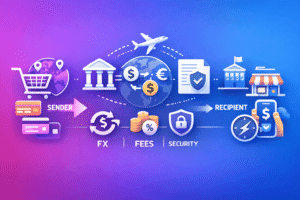
The complete guide to cross-border payments in 2026
Cross-border payments are no longer a niche capability. They are a core requirement for any business that wants to scale beyond a single market. What appears to be a simple transaction often involves multiple banks, payment networks, currencies, risk engines, and compliance checks operating across jurisdictions.
The challenge is not moving money. The challenge is controlling approval rates, cost, speed, FX exposure, and compliance risk as volume grows and margins tighten.
What cross-border payments really are
A cross-border payment is any transfer of value where the payer and the payee are in different countries or where the transaction is routed through foreign financial infrastructure. This includes card payments, bank transfers, local payment methods, wallets, and marketplace payouts.
Each additional country introduces more intermediaries, more regulation, and more potential points of failure. Domestic assumptions stop working the moment international expansion begins.
The four rails that power cross-border payments
Most businesses think they are choosing a provider. In reality, they are choosing which rails their money travels on.
Cards
Cards offer the fastest global reach and are essential for ecommerce, subscriptions, and consumer checkout. Their strength is availability. Their weakness is issuer behaviour.
Issuer risk models vary widely by country. Cross-border transactions are scrutinised more aggressively, carry higher interchange in many corridors, and see elevated dispute rates in specific regions. Without optimisation, approval rates often decline as geographic coverage expands.
Bank transfers
Bank rails dominate B2B payments, invoicing, treasury movement, and high-value payouts. They are dependable at scale but unforgiving when data quality is poor.
Incorrect beneficiary details, missing references, or unclear payment purposes can delay funds for days. As volume increases, exception handling and compliance reviews become the primary operational burden.
Remittance and transfer networks
These networks specialise in difficult corridors and last-mile delivery where traditional banking struggles.
They solve reach problems but often introduce higher fees and limited transparency. Pricing varies significantly by corridor, and reconciliation is often weaker than card or direct bank rails.
Local payment methods and account-to-account
Local payment methods increase trust and conversion in many markets. In some countries, they outperform cards entirely.
The challenge is fragmentation. Each method has its own settlement timelines, refund rules, dispute logic, and reporting standards. Scaling them without strong controls creates long-term operational complexity.
What actually happens during a cross-border payment
Understanding the lifecycle explains why issues are often misdiagnosed.
A typical cross-border transaction flows through:
Payment initiation
Risk and fraud screening
Authentication where required
Authorisation decision
Clearing and settlement
FX conversion, sometimes more than once
Reconciliation and reporting
Post-transaction events such as refunds, disputes, or compliance checks
Most providers expose only the final outcome. Experienced operators focus on visibility at each stage so problems can be identified and fixed rather than guessed.
The real problem is not declines, it is lack of visibility
Cross-border payments fail for many reasons, but most businesses cannot see which one applies.
You should always be able to determine:
Whether a failure originated from fraud rules, authentication, issuer policy, or routing
If currency or country mismatch increased issuer risk
Whether the transaction failed before or after authentication
Which issuer countries or BIN ranges underperform
How routing decisions affect approval rates and cost
Without this level of reporting, optimisation becomes opinion-driven and expensive.
Speed expectations in modern cross-border payments
Speed is now a trust metric. Customers expect international payments to move quickly and predictably.
While final crediting still varies by corridor and local banking infrastructure, multi-day delays should be treated as exceptions. When delays occur, providers should be able to explain precisely where time was lost and why.
Slow payments increase refund requests, support volume, and customer distrust.
Cost is rarely where businesses think it is
Headline processing fees almost never represent the true cost of cross-border payments.
Real cost includes:
Cross-border interchange and scheme fees
FX spreads and conversion timing
Intermediary bank fees
Refund and dispute handling costs
Reconciliation and operational overhead
FX is the most common silent margin killer. Many businesses optimise processing fees while losing more through currency conversion and refund FX exposure.
FX strategy affects both conversion and risk
FX is not just a pricing decision. It directly affects approval rates and customer confidence.
Practices that consistently perform well include:
Offering local currency pricing in priority markets
Aligning settlement currencies with the cost base
Tracking FX separately from processing fees
Defining how FX differences are handled on refunds
Avoiding accidental conversions caused by misaligned accounts
Currency mismatch is a frequent trigger for issuer declines and customer complaints, yet it is often overlooked during expansion planning.
Compliance is an operational risk, not a checkbox
Cross-border payments attract more scrutiny because more institutions are involved.
The most common triggers for delays or account issues include:
Weak KYB documentation
Unclear source of funds narratives
Business activity that does not match declared models
Rapid volume growth without explanation
High-risk vertical exposure without compensating controls
Poor transaction metadata
For direct server-to-server integrations, PCI Level 1 compliance should be treated as a foundational decision, especially when card data touches your environment at any point.
How experienced operators improve approval rates
Approval optimisation is not a single tactic. It is a system.
Data quality
Issuers respond to clarity. Accurate billing details, consistent descriptors, correct MCC classification, and enriched customer signals improve outcomes.
Authentication discipline
Authentication should be risk-based. Overuse damages conversion. Poorly implemented challenges increase abandonment without reducing fraud.
Intelligent routing
Working with a Payment Solution Provider and multiple acquirers allows routing decisions based on real performance rather than convenience.
Effective routing considers:
Approval rates by issuer country and BIN
Fraud and dispute ratios
FX and settlement costs
Stability and downtime history
Controlled decline recovery
Retries work when applied selectively.
Retry only on recoverable decline codes
Space retries based on issuer behaviour
Change routes or parameters on subsequent attempts
Avoid aggressive retry patterns that damage issuer trust
Common failure patterns during international expansion
The same issues appear repeatedly when businesses scale too quickly.
Issuer declines spike in new markets due to unfamiliar merchant signals
Refunds slow down and support volume increases
Disputes rise due to unclear descriptors or delivery expectations
Bank transfers arrive short because of intermediary fees or missing references
Each issue is solvable, but only when measured accurately.
What your provider stack must support
Whether you use a single PSP or a layered setup with a payment gateway partner and multiple acquirers, certain capabilities are non-negotiable.
You should expect:
Corridor-level performance reporting
Transparent fee and FX breakdowns
Strong reconciliation identifiers
Clear refund and dispute workflows
Incident transparency and uptime reporting
Compliance support that explains decisions
Cross-border payments are no longer background infrastructure. They are a core operational system that directly affects growth, margin, and customer trust.
How FastoPayments fits into modern cross-border payments
FastoPayments was built around the realities described in this guide rather than legacy assumptions about how payments should work.
Instead of treating cross-border payments as a single flow, FastoPayments supports merchants through a layered setup that combines a Payment Solution Provider model with multiple acquirer relationships and a flexible gateway partner. This structure allows routing, authentication, FX handling, and risk controls to be adjusted by market rather than forced into a single global configuration.
In practice, this gives merchants greater visibility into approval rates by corridor, better control over FX exposure, and the ability to scale into new countries without rebuilding their payment infrastructure each time. Compliance, reporting, and reconciliation are designed to support growth rather than slow it down.
FastoPayments does not replace good payment strategy. It enables it.
If you want, next we can tighten this for a specific vertical such as ecommerce, marketplaces, adult, or POS, or adapt the FastoPayments section to align precisely with how you want to position the brand commercially.
What is payment orchestration
Payment orchestration is a control layer that manages how transactions are routed across multiple acquirers and payment methods. It uses factors such as country, BIN, MCC, payment method, and historical approval rates to decide the most effective route for each transaction.
How does payment orchestration improve approval rates
Payment orchestration improves approval rates by routing transactions to the acquirer or payment method that performs best for a specific country, issuer, or BIN. It also enables intelligent retries, local payment method prioritisation, and automatic failover when performance degrades.
What is the difference between a payment gateway and payment orchestration
A payment gateway transmits transaction data between checkout and a processor. Payment orchestration controls how payments behave by making routing, retry, failover, and payment method decisions across multiple providers based on real-time and historical data.
Do small and mid-sized businesses need payment orchestration
Payment orchestration becomes valuable as soon as a business operates across multiple markets, uses more than one acquirer, or experiences approval volatility. It is not limited to large enterprises and is often most impactful for growing cross-border merchants.
What are the benefits of payment orchestration for cross-border payments
For cross-border payments, payment orchestration enables local acquiring, local payment methods, and issuer-aware routing. This reduces declines, lowers cross-border fees, improves customer trust, and increases overall conversion rates.
💡 Interested in learning more about what’s included in a typical high-risk merchant account? View our complete breakdown of FastoPayments’s high-risk merchant accounts.