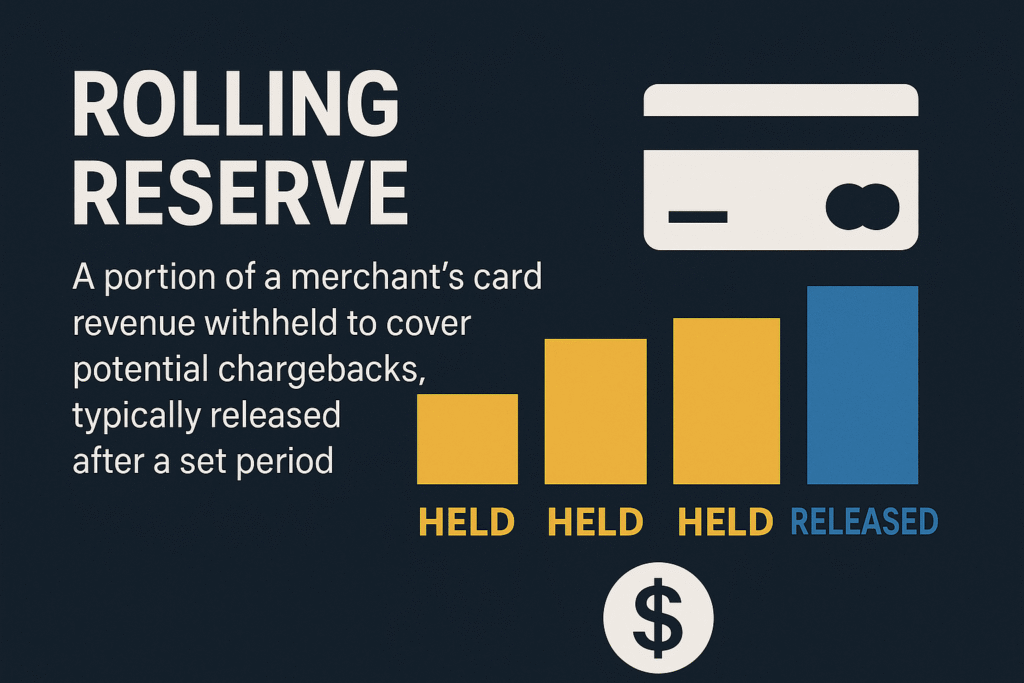
A rolling reserve is a share of your card sales that your acquirer holds back for a set period before paying it out. It covers chargebacks and refunds that arrive after the sale, and it is one of the most common conditions in a high-risk merchant account.
A reserve is not a fee. It is still your money, and it is paid out on a schedule. But it affects your cash flow, so it pays to understand how it works and how to get better terms. This guide explains how rolling reserves are calculated, why acquirers use them, the different types, and how to get a reserve reduced or removed.
Key takeaways
- A rolling reserve holds a percentage of each settlement, commonly 5% to 10%, for a fixed period, commonly 90 to 180 days, then releases it.
- Acquirers use reserves because cardholders can dispute payments months after the sale, and the acquirer is liable if the merchant can’t pay.
- Reserves can be uncapped, capped at a fixed amount, or prepaid up front. A capped reserve is easier on cash flow.
- Reserves are set by your acquirer, not by Visa or Mastercard, so they can be negotiated.
- A clean dispute history, good fraud controls and regular reporting are what get reserves reduced or removed.
What is a rolling reserve?
A rolling reserve is a percentage of a merchant’s card sales that the acquirer withholds from each settlement and keeps for an agreed hold period. When the hold period ends, those funds are released to the merchant, while new funds are held from current sales. The reserve “rolls” forward, so there is always a balance held against recent sales.
For example, with a 10% reserve and a 180-day hold, 10% of every settlement is held back, and each amount is paid out 180 days after it was held.
A rolling reserve can be seen as an unwanted saving, but ultimately it is still the merchant’s money and will be paid out accordingly and in due time, whether still processing or not.
Dennis E.R. Pedersen, CEO and Founder of FastoPayments
Why acquirers use rolling reserves
When you take a card payment, your acquirer pays you within days. But the cardholder can dispute that payment much later. If you can’t cover a chargeback, for example because your balance is empty or the business has closed, the acquirer has to pay it. The reserve is the acquirer’s protection against that.
- Chargeback windows are long. In most cases a cardholder can dispute a payment up to 120 days after the transaction. Where goods or services are delivered later, such as travel, events or pre-orders, Visa allows disputes up to 540 days after the transaction.
- Subscriptions multiply exposure. Each monthly payment is a separate transaction, so a customer can dispute several months of charges at once.
- Card scheme monitoring. Acquirers are measured on the fraud and disputes across their whole portfolio under programmes such as Visa VAMP. Reserves are one way they manage that exposure.
- Limited history. New merchants, and merchants switching from another provider, often start with a reserve until they have built up processing history with the new acquirer.
Reserves are most common in industries with higher dispute rates or delayed delivery, such as adult, dating, gaming, nutraceuticals, travel and subscription businesses. That is why they come up so often with a high-risk merchant account.
How a rolling reserve works: an example
Here is how a 10% reserve with a 180-day hold builds up for a merchant whose sales grow month by month. The figures are an example, not typical values.
| Month | Card sales | 10% held | Released (held six months earlier) | Reserve balance |
|---|---|---|---|---|
| Month 1 | 100,000 EUR | 10,000 EUR | 0 EUR | 10,000 EUR |
| Month 2 | 120,000 EUR | 12,000 EUR | 0 EUR | 22,000 EUR |
| Month 3 | 130,000 EUR | 13,000 EUR | 0 EUR | 35,000 EUR |
| Month 4 | 110,000 EUR | 11,000 EUR | 0 EUR | 46,000 EUR |
| Month 5 | 140,000 EUR | 14,000 EUR | 0 EUR | 60,000 EUR |
| Month 6 | 150,000 EUR | 15,000 EUR | 0 EUR | 75,000 EUR |
| Month 7 | 160,000 EUR | 16,000 EUR | 10,000 EUR | 81,000 EUR |
For the first six months, the merchant only pays in. From month 7, releases start and the balance levels off at roughly six months of 10% holds. That build-up period is the real cash-flow cost, so plan for it when you start with a new acquirer.
If you stop processing, the reserve is not lost. The acquirer keeps it until the hold period on the last transactions has ended, deducts any chargebacks that came in, and pays out the rest.
Types of reserve
| Type | How it works | Effect on cash flow |
|---|---|---|
| Uncapped rolling reserve | A percentage of every settlement is held for the hold period, with no upper limit. | The balance grows with your sales. |
| Capped rolling reserve | A percentage is held until the balance reaches a fixed cap, for example 50,000 EUR. After that, nothing more is held. | Predictable once the cap is reached. |
| Prepaid (upfront) reserve | The cap amount is deposited or withheld before or at the start of processing. After that, settlements are paid in full. | A one-off cost up front, then full payouts. |
Acquirers can also use other tools, such as delayed settlement or a minimum balance, sometimes alongside a reserve. Read your agreement for the exact percentage, hold period, cap and what happens when the account closes.
What affects the size of your reserve
- Your industry and business model. Delayed delivery, subscriptions and free trials all increase the acquirer’s exposure.
- Your dispute and fraud history. Your chargeback ratio, fraud reports and refund rate over the last months.
- Your processing history. How long you have processed, how stable your volume is, and statements from previous providers.
- Your average transaction size. Higher tickets mean more money at stake per dispute.
- Your company’s financial position. Accounts and capital can matter, especially for newer businesses.
How to get a rolling reserve reduced or removed
Most acquirers review reserves periodically. You can speed that up by giving them reasons to trust your numbers.
Keep disputes low and stable
A clean, steady dispute profile is the strongest argument you have. Use clear billing descriptors, easy refunds, renewal reminders and pre-dispute tools so problems are solved before they reach the bank. Our guide to preventing chargebacks covers the details.
Show your fraud controls work
Use 3D Secure, AVS and CVV checks, and velocity rules. What persuades an acquirer is not the tools themselves but evidence that fraud reports and disputes went down after you added them.
Treat refunds as a risk control
A fast refund prevents a chargeback. Publish a simple refund policy, show it at checkout and in confirmation emails, and track how quickly you process refund requests.
Keep your volume predictable
Sudden spikes make acquirers nervous. Tell your acquirer in advance about big campaigns, seasonal peaks, new products or new countries.
Report before you are asked
Send your acquirer a short, regular update: sales, refunds, dispute and fraud ratios with reason codes, what you changed since the last review, and the reserve change you are asking for.
Negotiate the structure, not just the percentage
If the percentage won’t move, ask for:
- a cap, so the balance stops growing;
- a shorter hold period after a probation period with clean numbers;
- a switch from uncapped to capped after a set period;
- a prepaid reserve, so future settlements are paid in full;
- a release of any balance well above your recent chargeback exposure.
Back each request with data. If your monthly chargebacks have never come close to a certain amount, propose a cap based on that figure plus a buffer.
Frequently asked questions
What is a rolling reserve?
A rolling reserve is a percentage of your card sales that your acquirer holds back for a fixed period to cover future chargebacks and refunds. Each held amount is released when its hold period ends, while new amounts are held from current sales.
What is a typical rolling reserve percentage?
Reserves are commonly 5% to 10% of sales, held for around 90 to 180 days. High-risk merchants and businesses with delayed delivery can see higher percentages or longer holds. The exact terms are set by your acquirer.
Is a rolling reserve a fee?
No. A rolling reserve is your money held as security. It is paid out when the hold period ends, minus any chargebacks or refunds it was used to cover.
What is the difference between a capped and an uncapped reserve?
An uncapped reserve keeps growing with your sales. A capped reserve stops growing once the balance reaches a fixed amount, which makes your cash flow more predictable.
What is a prepaid reserve?
A prepaid reserve is a fixed amount deposited or withheld at the start of processing. Once it is in place, your settlements are paid in full without further holdbacks.
Can a rolling reserve be removed?
Yes. Acquirers can reduce or remove a reserve once you have built up a stable processing history with low chargeback and fraud ratios. Regular reporting and early communication help.
What happens to my reserve if I close my merchant account?
The acquirer keeps the reserve until the hold period on your last transactions has ended, uses it to cover any chargebacks or refunds that arrive, and then pays out the balance.
Next step
Reserve terms make a real difference to your cash flow, so compare them as carefully as the processing rates. Fasto works with adult, subscription, nutraceutical, gaming, dating and hospitality merchants, and we explain the reserve terms for your business before you sign. Approval typically takes two to three weeks.
Get a free quote and ask us about reserve terms for your business.