For many businesses, what shows up on a customer’s bank statement might seem like a small detail. But in industries where discretion matters, that single line of text can make or break trust.
Discreet billing lets merchants take payments while keeping sensitive purchases private. This guide covers what discreet billing means, how it works, what a discreet charge looks like on a statement, who needs it, and how to set it up without breaking card scheme rules or causing chargebacks.
Key takeaways
- Discreet billing means the charge on a customer’s statement shows a neutral business name instead of a name that reveals what they bought.
- It works through the billing descriptor, the short text your payment processor sends with every transaction.
- It is legal and allowed by Visa and Mastercard, as long as the descriptor is not misleading and the customer can still recognise the charge and contact you.
- Too vague a descriptor causes “I don’t recognise this” chargebacks. Too specific a descriptor exposes the customer. The right balance protects both.
- Showing the descriptor at checkout and in the confirmation email is the simplest way to keep disputes down.
What is discreet billing?
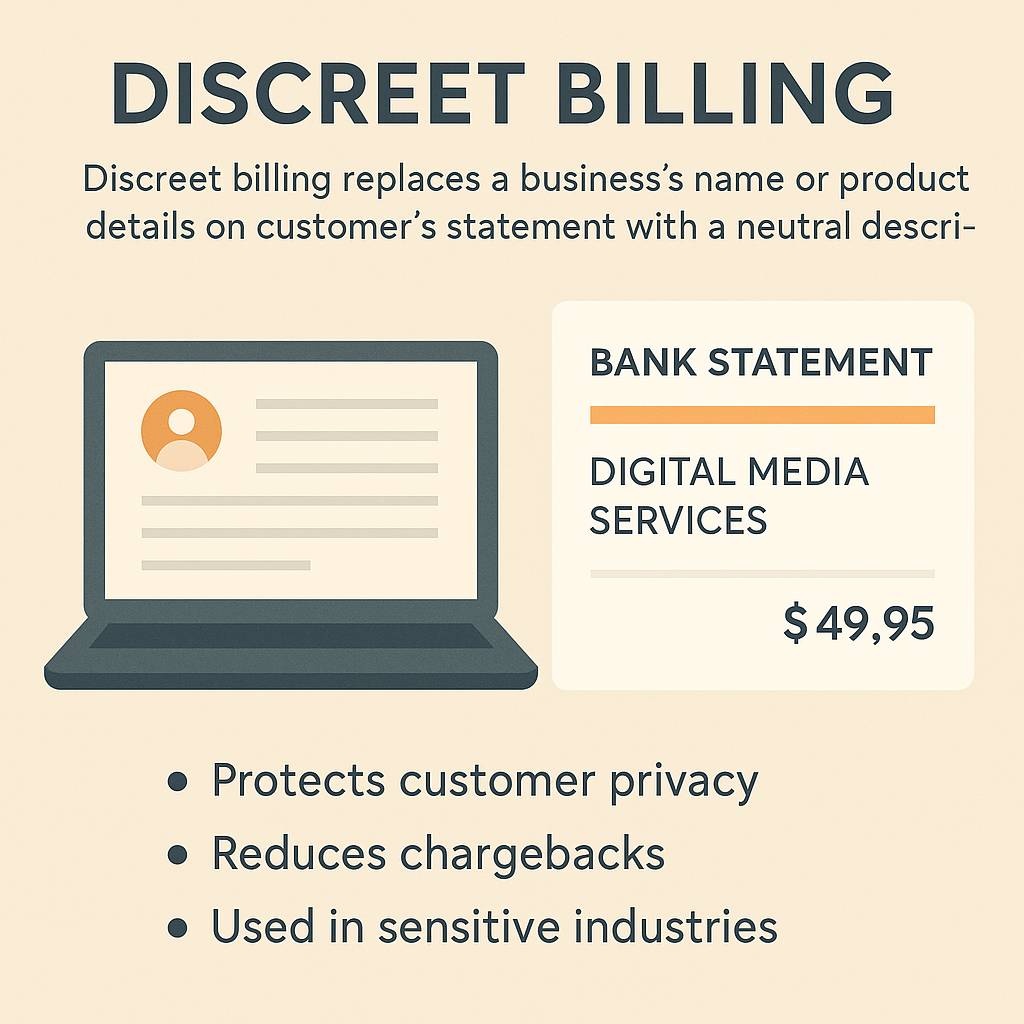
Discreet billing is a way of processing payments where a neutral, non-identifying name appears on the customer’s bank or card statement instead of a brand name or product description that reveals what was bought.
For example:
- Instead of “EliteCamsXXX”, the customer sees “Online Media EU”.
- Instead of “PleasureBox”, they see “Wellness Services”.
The idea is not to hide the transaction from the customer, but to protect them from unwanted questions from anyone else who sees the statement, such as a partner, family member or employer.
Discreet billing is common in high-risk industries, but it is valuable in any business where privacy is part of the customer experience.
How discreet billing works
Every card payment carries a billing descriptor: a short piece of text that the card issuer shows on the customer’s statement and in their banking app. Your payment processor sets it up with you during onboarding and sends it with each transaction.
A descriptor usually contains:
- a business or brand name, which for discreet billing is a neutral one;
- a customer support phone number or website, so the customer can reach you.
The space is limited. The name part is typically around 22 to 25 characters, depending on the card scheme and processor, so the descriptor needs to be short and clear.
The goal is to keep the descriptor generic enough to protect the customer’s privacy, but clear enough that they recognise it. If it is too vague, customers won’t remember the purchase and may dispute it. If it is too specific, their privacy is gone.
What a discreet charge looks like on a statement
A customer who paid a merchant using discreet billing would typically see something like:
| Instead of | The statement shows |
|---|---|
| The site or brand name | A neutral company name, for example “OM Digital Services” |
| A product description | A general category, for example “Online Media” or “Wellness” |
| Nothing to help the customer | A support website or phone number, for example “help-om.com” |
The amount, date and currency appear as normal. Discreet billing changes the name, not the transaction.
Who needs discreet billing?
Discreet billing is useful for businesses that handle private, personal or sensitive purchases, for example:
- adult content platforms, such as fan sites, cam sites and subscription services;
- online dating apps and matchmaking services;
- sexual wellness and intimacy product retailers;
- mental health, therapy or counselling platforms;
- telehealth services and online pharmacies for personal health products;
- CBD and alternative wellness stores;
- spiritual services, psychic readings or life coaching;
- debt relief or credit improvement services.
Even when a product is completely legal, customers may still prefer discretion. Respecting that builds loyalty and repeat business.
Examples of discreet billing in practice
A fan platform using a neutral descriptor
A subscription platform for adult creators bills members as “StreamMedia Ltd”. It shows that name on the checkout page and in every receipt, so members recognise it, while anyone else glancing at the statement sees nothing revealing.
A mental health app keeping it simple
A therapy app uses “MindSupport Digital”. Users recognise the name, but the statement doesn’t say that it relates to counselling.
A store selling intimate wellness products
An online retailer of personal wellness products uses “Wellbeing Solutions”. Customers get a professional, private service without worrying about their statement.
In each example, the merchant protects privacy while keeping the charge recognisable enough to avoid confusion.
Five ways to implement discreet billing
1. A neutral business name
Use a name that gives no hint of the product category. Avoid words like “adult”, “dating” or anything that could raise questions. Ideally, it is the name of the legal entity or a registered trading name, so it is accurate as well as discreet.
2. Dynamic descriptors
Some processors let you change part of the descriptor per transaction, for example to show which of your sites or products the charge is for. This suits platforms with several brands, but every variation still has to be recognisable and not misleading.
3. One parent company name
Multi-brand businesses can bill all their brands under one neutral parent company name. This keeps every brand discreet, as long as customers are told the name at checkout.
4. Alternative payment methods
Some customers prefer to pay with prepaid cards or e-wallets, so the purchase doesn’t appear on their main card statement at all. Offering alternative payment methods alongside cards gives privacy-minded customers a choice.
5. Support details in the descriptor
Include a support website or phone number. If a customer doesn’t recognise a charge, they can contact you instead of their bank, and you can refund before it becomes a chargeback.
How to avoid chargebacks with discreet billing
The biggest risk with discreet billing is the customer who forgets what “Online Media EU” was and calls their bank. These habits prevent most of those disputes:
- Show the descriptor at checkout. A line such as “This charge will appear on your statement as ONLINE MEDIA EU” next to the pay button.
- Repeat it in every receipt and renewal email. Especially for recurring billing, where the next charge may come a month later.
- Make the support contact work. A website or phone number in the descriptor is only useful if someone answers.
- Refund quickly. A fast refund costs less than a chargeback and doesn’t count towards your dispute ratio.
- Use pre-dispute tools. Alert services and order-detail sharing with issuers help customers recognise a charge before they dispute it.
Our guide to preventing chargebacks covers this in more detail.
Benefits of discreet billing for your business
- Fewer chargebacks from customers who don’t recognise, or don’t want to explain, a charge.
- More trust, because customers can see you care about their privacy.
- A better reputation in industries where discretion is expected.
- More repeat purchases from customers who feel safe buying from you.
In many cases, discreet billing is the final detail that makes a customer feel safe enough to buy.
Is discreet billing legal?
Yes. Discreet billing is legal, as long as it does not mislead the customer. The descriptor can be general, but it must not be deceptive, and customers must still be able to identify the purchase and contact the merchant.
Visa and Mastercard allow neutral descriptors, but they expect the name to be one the cardholder can recognise. Using a descriptor to hide what a business really sells from the card schemes or the acquirer is a different matter: that is miscoding, and it breaks scheme rules. Your merchant category code (MCC) still has to reflect what you sell, whatever name appears on the statement. Working with a payment processor that knows your industry helps you stay on the right side of these rules.
Frequently asked questions
What does discreet billing mean?
Discreet billing means the charge on a customer’s bank or card statement shows a neutral or generic business name instead of revealing the product, service or brand involved. The transaction is still real and traceable, but the wording doesn’t draw attention.
Is discreet billing allowed by Visa and Mastercard?
Yes, as long as it is not misleading. The descriptor must still let the customer recognise the charge, and support contact details should be available. The merchant category code must still reflect what the business sells.
Can discreet billing reduce chargebacks?
Yes, if the descriptor is neutral but recognisable. Customers are less likely to dispute a charge they recognise and are not embarrassed by. A descriptor that is too vague can have the opposite effect.
What will a discreet charge look like on my statement?
Usually a neutral company name, such as “Online Media” or a short company name, often with a support website or phone number. The amount and date show as normal.
How long can a billing descriptor be?
The name part is short, typically around 22 to 25 characters, depending on the card scheme and the payment processor. Ask your processor for its exact limit.
Does discreet billing hide the purchase from my bank?
No. Your bank still processes the transaction and knows which merchant it went to. Discreet billing only changes the name shown on your statement and in your banking app.
Next step
Discreet billing is not about hiding. It is about giving customers a safer, more comfortable experience. Fasto works with adult, subscription, nutraceutical, gaming, dating and hospitality merchants, and we can help you choose a descriptor that protects your customers while staying within card scheme rules. Approval typically takes two to three weeks.
Get a free quote, or read more about our high-risk merchant accounts.