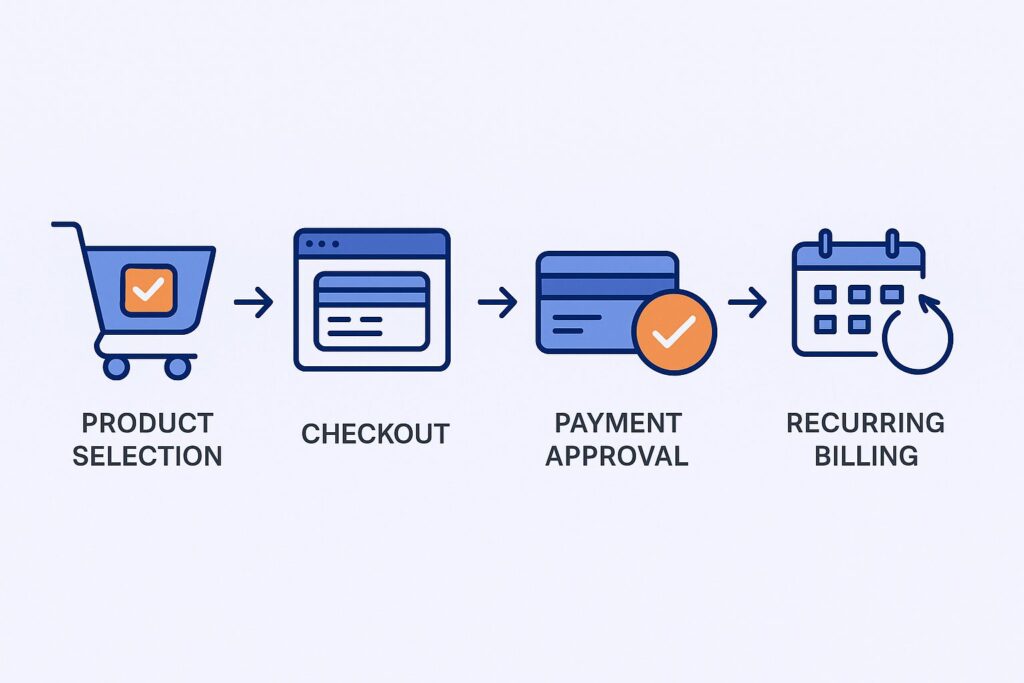
Recurring billing is a payment model where a business charges a customer automatically on a regular schedule, for example every month, until the customer cancels. It is how subscriptions, memberships and most software are paid for.
For merchants, recurring billing means predictable revenue. It also brings its own risks: failed renewals, forgotten subscriptions that turn into chargebacks, and card scheme and consumer rules that are stricter than for one-off sales. This guide explains how recurring billing works, the different models, the rules you need to follow, and how to keep failed payments and disputes down.
Key takeaways
- Recurring billing charges a stored payment method automatically on a schedule until the customer cancels or the plan ends.
- The first payment is authenticated by the customer. Later charges are merchant-initiated and normally don’t need 3D Secure, as long as the first payment set them up correctly.
- Visa has specific rules for free trials and introductory offers, including a reminder seven days before the first full charge.
- Failed renewals are often recoverable with card updater services, sensible retries and reminders to update card details.
- Forgotten renewals are a major source of chargebacks. Clear descriptors, reminders and easy cancellation keep your dispute ratio down.
What is recurring billing?
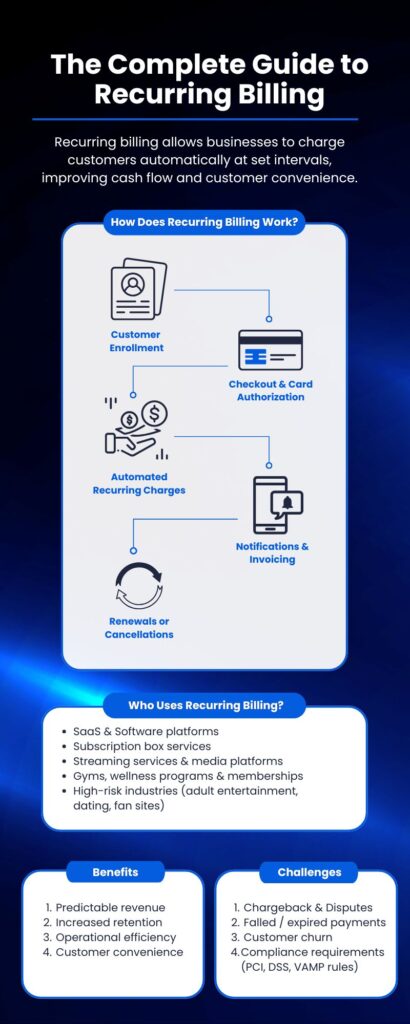
Recurring billing is an automated process where a customer is charged on a regular schedule, such as weekly, monthly, quarterly or yearly, for continued access to a product or service. The customer agrees once, their payment details are stored securely by the payment provider, and each later payment is taken automatically.
The difference from a one-time payment is the ongoing agreement. The merchant has permission to charge the card again, on the terms the customer accepted, until the customer cancels or the subscription ends.
Types of recurring payments
Fixed recurring payments
The same amount is charged at the same interval, for example a monthly membership. This is the most common model for subscriptions, content platforms and software.
Usage-based payments
The amount depends on what the customer used, such as API calls or data. The schedule is regular but the amount changes.
Free trial or introductory offer, then recurring
The customer starts with a free or discounted period, then moves to the full price. This lowers the barrier to sign up but carries the highest dispute risk, because customers forget the trial is ending. Card schemes have specific rules for this model (see below).
Hybrid models
A set-up fee followed by monthly billing, or a base fee plus usage charges.
How recurring card payments work
- Sign-up. The customer chooses a plan and sees the price, billing interval and cancellation terms before paying.
- First payment and consent. The customer pays and agrees to future charges. In the EEA and UK, this first payment is usually authenticated with 3D Secure.
- Card storage. The card details are stored as a token by your payment provider, so you never hold the card number yourself. See our guide to tokenisation.
- Automatic renewals. Each later payment is sent as a merchant-initiated transaction, referencing the original agreement. These are outside the scope of strong customer authentication, so the customer doesn’t need to approve each one.
- Changes and cancellation. The customer can upgrade, downgrade or cancel, and you stop charging when they do.
Getting step 2 right matters. If the first payment isn’t set up correctly as the start of a recurring agreement, later charges may be declined or challenged by the issuer.
Who uses recurring billing?
- software and SaaS platforms;
- subscription content, fan and creator platforms;
- dating and membership sites;
- nutraceutical and subscription box businesses;
- online education platforms;
- gyms and wellness memberships.
Several of these, including adult, dating and nutraceuticals, are high-risk industries, partly because recurring billing increases dispute risk. If that’s you, a subscription merchant account from a provider that understands your model is the place to start.
Benefits of recurring billing
- Predictable revenue that makes forecasting and planning easier.
- Convenience for customers, who don’t have to pay manually each time.
- Less admin, because invoicing and collection are automated.
- Longer customer relationships and higher lifetime value.
Card scheme rules for free trials and introductory offers
Visa introduced specific rules in 2020 for merchants that offer free trials or introductory prices that turn into recurring payments. In summary, merchants must:
- disclose the terms at checkout: the trial length, the amount and date of the first full charge, the billing frequency and how to cancel;
- get express consent to future charges, for example with a checkbox or button that makes clear the customer will be charged;
- send a confirmation straight after sign-up with the terms and cancellation instructions;
- send a reminder at least seven days before the trial or introductory period ends, with the amount, date and how to cancel;
- make cancellation easy and explain how in the confirmation and reminder;
- flag the first full charge in the billing descriptor, for example with “trial”.
Mastercard has similar rules for trials of physical products. Ask your acquirer exactly what applies to your business, because breaking these rules makes “misrepresentation” chargebacks very hard to win.
Challenges of recurring billing
Chargebacks
Customers forget subscriptions, don’t recognise a renewal on their statement, or find it easier to dispute than to cancel. Each of those becomes a chargeback that counts towards your dispute ratio, and under Visa VAMP fraud reports and disputes are measured together. Too many lead to higher reserves, card scheme monitoring or a closed account.
Failed payments
Scheduled charges fail for ordinary reasons:
- expired or replaced cards;
- insufficient funds on the billing date;
- issuer declines, for example from fraud checks;
- closed accounts.
Ways to recover them:
- use card updater services (Visa Account Updater and Mastercard Automatic Billing Updater) through your provider, so stored cards are refreshed when a bank issues a new one;
- retry carefully: only on recoverable decline codes, spaced out over days, and never endlessly, because card schemes limit retries and repeated declines hurt your standing with issuers;
- ask customers to update their card before it expires and as soon as a payment fails;
- offer another payment method, such as a local method or SEPA Direct Debit for euro customers.
Our guide to improving approval rates covers more.
Churn
Churn is the share of subscribers who cancel or don’t renew. Clear communication, flexible plans (pause, downgrade) and asking why people leave all help. A customer who cancels cleanly is far better for you than one who disputes.
How to reduce disputes on recurring billing
- Use a billing descriptor customers recognise, with your brand name and a support contact. For sensitive products, see our guide to discreet billing.
- Send renewal reminders, especially before annual renewals and price changes.
- Make cancelling as easy as signing up.
- Refund quickly when a customer complains, before they go to their bank.
- Use pre-dispute tools such as alert services, so you can refund before a dispute becomes a chargeback.
Read our full guide to preventing chargebacks.
Compliance requirements
PCI DSS
The Payment Card Industry Data Security Standard applies to any business that stores, processes or transmits card data. Using your provider’s tokenisation and hosted payment pages keeps card numbers out of your systems and greatly reduces the PCI work on your side.
Consumer protection
Consumer law in the EU and UK requires clear information before purchase and fair cancellation terms, and online customers usually have a right to withdraw from a contract within 14 days, with some exceptions for digital content. Some countries have extra rules for subscriptions and automatic renewals. Check the rules in each market you sell to.
Data protection
If you serve customers in the EU or UK, the GDPR governs how you collect and store their personal data, including billing details.
Frequently asked questions
What is recurring billing?
Recurring billing is when a business charges a customer automatically on a regular schedule, such as monthly, using payment details the customer agreed to store. It continues until the customer cancels or the subscription ends.
What is the difference between recurring billing and subscription billing?
The terms are often used interchangeably. Subscription billing usually means a fixed plan for ongoing access, while recurring billing is the broader term for any repeated automatic charge, including usage-based billing.
Do recurring payments need 3D Secure?
In the EEA and UK, the first payment that sets up the recurring agreement usually needs strong customer authentication, such as 3D Secure. Later merchant-initiated charges for the agreed amount don’t normally need it.
What are Visa’s rules for free trials?
Merchants must disclose trial terms at checkout, get express consent to future charges, send a confirmation, send a reminder at least seven days before the trial ends, make cancellation easy, and flag the first full charge in the descriptor.
Why do recurring payments fail?
Common reasons are expired or replaced cards, insufficient funds, issuer fraud checks and closed accounts. Card updater services, careful retries and reminders to update card details recover many of them.
Why do subscription businesses get more chargebacks?
Customers forget about subscriptions, don’t recognise renewals on their statements, or find disputing easier than cancelling. Clear descriptors, reminders and simple cancellation reduce this.
Is recurring billing high risk?
Not always, but acquirers watch it closely because of dispute risk. Subscriptions in industries such as adult, dating and nutraceuticals, and models with free trials, are usually treated as high risk.
Next step
If your business runs on subscriptions, the right acquirer makes renewals and disputes much easier to manage. Fasto works with adult, subscription, nutraceutical, gaming, dating and hospitality merchants, and approval typically takes two to three weeks.
Get a free quote, or read more about our high-risk merchant accounts.