
Key Takeaways
- The Compounding Compliance Curve is Fasto’s framework: every month of clean, compliant processing history compounds into better terms, just like interest on savings. Stop treating compliance as flat overhead.
- Strong chargeback compliance leads to lower processing fees, higher volume limits, faster settlements, and rolling reserve reductions. These are not abstract benefits. They are real money back in your business.
- Merchants who treat compliance as a “tax” stay on a flat line. Merchants who treat it as an investment ride an upward curve that accelerates over time.
- Visa’s VAMP “Excessive” threshold dropped from 2.2% to 1.5% on 1 April 2026 for the EU, UK, US, Canada and Asia Pacific. The margin for error has shrunk. Clean history is no longer optional. It is a survival strategy.
- This article is written for adult, gambling, CBD, nutra, crypto, and vape merchants who want to keep their accounts live and scalable through 2026 and beyond.
Introduction: Why Your “Risk Story” Beats Your “Sales Story”
Here is a truth most high-risk merchants learn the hard way: acquiring banks care more about your risk story than your sales story. You can show a bank a hockey-stick revenue chart and they will nod politely. Then they will ask about your chargeback ratio, your fraud rate, your KYC documentation, and your AML procedures. That is the conversation that decides whether you get boarded, what you pay, and whether you stay live.
Fasto works daily with adult, gambling, CBD, nutra, crypto, and vape merchants. We see the data. We know what acquirers actually reward. And it is not the merchant with the flashiest checkout page. It is the merchant with the cleanest processing history 😅. You would be amazed how many operators obsess over button colours on their payment page while ignoring the compliance processes that determine whether they get paid at all.
This is not a theoretical issue. Enforcement has tightened across the board. The EU’s MiCA framework now governs crypto asset service providers. PSD2 and Strong Customer Authentication rules are being enforced harder across Europe. And Visa’s VAMP programme has lowered its thresholds. The pressure is real and rising. In this article you will learn Fasto’s Compounding Compliance Curve framework, see two contrasting merchant scenarios, and walk away with a practical plan you can start this quarter.
Definition: What Is The Compounding Compliance Curve?
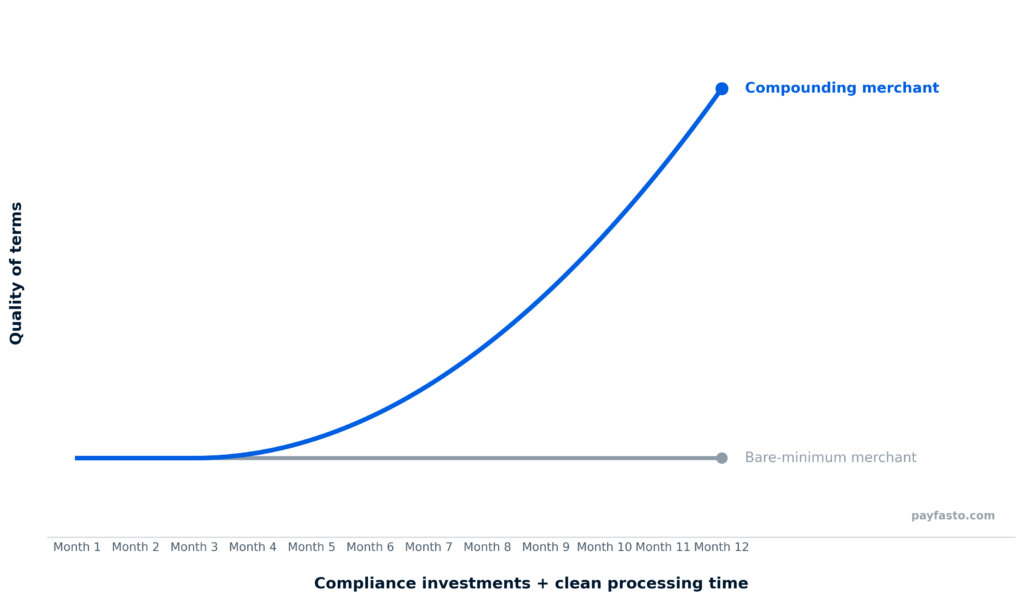
Definition: The Compounding Compliance Curve is Fasto’s framework describing how a merchant’s cumulative clean processing history earns progressively better terms from acquirers and PSPs over time, including lower fees, higher limits, faster settlements, and reduced rolling reserves.
“Clean history” means low and stable chargeback ratios, low fraud reports, strong KYC and AML adherence, and transparent business practices. It does not mean slapping a compliance badge on your website and calling it a day.
The logic is borrowed from compound interest. Each month of good data is a deposit. The more months you stack, the steeper the upward curve, because each additional month of clean data reduces your perceived risk more than the last one did. Like interest on a savings account, the gains accelerate.
Contrast this with the “flat line” model, where merchants assume compliance is a fixed monthly cost with no long-term upside. They pay the same, suffer the same reserves, and wonder why nothing improves.
The Old Model: Compliance As A Tax To Minimise
Many high-risk merchants see compliance, KYC, enhanced due diligence, and chargeback tools as a painful tax on growth. Something to endure, not embrace. When you treat compliance as a cost to cut, you set yourself up to crack under the first real pressure.
Common behaviours in the “tax” mindset:
- Doing bare-minimum KYC, just enough to pass onboarding
- Ignoring representments and letting chargebacks pile up
- Delaying responses to dispute notifications until the PSP sends a warning letter
- Cutting corners on card scheme rules because “nobody checks”
- Treating compliance as someone else’s problem
Think of it like a gym membership you pay for but never use. You are spending the money, but your fitness, your risk curve, stays flat. Worse, this attitude leads to reactive firefighting, sudden account closures, and constant PSP hopping. Each hop resets your history and makes banks even more nervous.
And the downside is not hypothetical. Cross Visa’s or Mastercard’s monitoring thresholds and you face real fines, escalating month after month, on top of the chargeback losses themselves. That is not a tax. That is a penalty for neglect.
The New Model: Compliance As An Investment That Compounds
The mindset shift is simple but powerful: treat compliance operations as a performance asset that grows in value over time, not an expense line to squeeze.
Think of it like compound interest. Every compliant month is a deposit. The interest is the improving terms your acquirer offers. After three months, the interest is modest. After twelve months, it starts to feel meaningful. After two years, it is transformational. The first stretch of the curve is always the hardest. Progress feels slow. But the maths works in your favour if you stick with it.
What does “investment” look like in practice?
- A structured chargeback compliance programme with clear ownership
- Proactive fraud controls (geolocation, velocity checks, device fingerprinting)
- A well-maintained KYC data room with current documentation
- Documented refund, cancellation, and support policies aligned with card scheme rules
- Weekly monitoring, not just monthly reporting
Banks and PSPs assess you on rolling data windows, often 3, 6, and 12 months. Each extra month of strong performance strengthens your position at the next review. Your data speaks for you when you are not in the room.
Flat Line vs Upward Curve: The Two Merchant Paths
Picture a simple two-line graph. The horizontal axis is your strategic compliance investment and clean processing time. The vertical axis is the quality of your terms: fees, limits, reserves, and settlement speed combined.
The first line is the “cost avoidance” merchant. It runs nearly flat. This merchant does just enough to stay under scheme thresholds. Terms barely change. The curve is stuck.
The second line is the Compounding Compliance Curve merchant. It rises gently in the first few months, then steepens as clean data accumulates, and accelerates further past the one-year mark. Milestones along the way: a first fee review, a limit increase, a settlement-speed improvement, and a rolling reserve reduction.
How Acquirers Actually Think About Risk
Behind every high-risk merchant account there is a risk model. Acquirers and PSPs like Fasto use these models to predict losses and set terms accordingly.
Main inputs to that model:
- Chargeback ratio and trend direction (improving, stable, or deteriorating)
- Fraud rate and patterns (TC40 reports, unauthorised transaction frequency)
- KYC and AML completeness and currency
- Sector risk classification (adult, gambling, CBD, and crypto all carry higher baseline scores)
- Processing volumes and transaction size patterns
- Legal and regulatory exposure by country
Acquirers care more about the shape and direction of your history than one bad week. A long stretch of clean data is a powerful bargaining chip. The European Banking Authority’s guidance on risk-based AML supervision makes this risk-based view mandatory, not optional. Banks are required to continuously assess and price risk. That means your performance data is your price tag.
The Four Levers Your Clean History Improves
Clean processing history moves four levers that merchants actually feel:
- Pricing (MDR, per-transaction fees)
- Limits (monthly volume caps, ticket size)
- Settlement speed (how fast you get paid)
- Reserves (how much of your money is locked away)

Different acquirers adjust these in different orders, but the pattern is consistent across EU, UK, and offshore banks. Each lever tends to improve non-linearly over time, which is the curve in action. Fasto actively manages these levers for merchants and advocates for better terms once the data supports it.
Lever 1: Lower Processing Fees Over Time
Discount rates and per-transaction fees in high-risk sectors are tied to risk, not just volume, and high-risk processing often carries higher fees than standard accounts. A merchant processing €2 million a month still pays premium rates if their chargeback ratio is ugly.
When a merchant stabilises chargebacks below scheme thresholds and demonstrates consistent fraud prevention, they can make the case for a lower MDR at the 6 to 12 month review.
Illustrative example: a CBD merchant starts at 5.5% MDR. After implementing structured dispute management, their chargeback ratio drops from 1.1% to 0.4% over twelve months. At the annual review, the rate is renegotiated to 4.2%. On €500,000 monthly volume, that 1.3% difference is roughly €78,000 a year.
Clean history can also unlock access to cheaper local payment methods, which further reduces blended costs. Everyone likes a discount, including banks, as long as the numbers earn it first 😄.
Lever 2: Higher Limits And Volume Flexibility
Many high-risk merchants are boarded with conservative caps. Monthly limits of €100,000 or maximum ticket sizes of €200 are common starting points.
After 3 to 6 months of consistent performance without spikes in dispute activity, those caps can be renegotiated. Illustrative example: an adult subscription business starts at €100,000 a month. After three stable months the cap rises to €250,000. After nine months, €500,000. Each safe increase proves the model and makes the next one easier to justify.
Acquirers also care about seasonality and promotions. Merchants who warn their PSP ahead of a big campaign, a new creator launch, or a holiday push earn more trust than those who spring traffic spikes without warning. That is compounding in action: trust built today buys flexibility tomorrow.
Lever 3: Faster Settlement And Cash Flow Relief
Settlement frequency is a hidden risk control. Newer or riskier accounts often sit on weekly or bi-weekly settlement while low-risk merchants enjoy T+1 or T+2, and traditional banks tend to impose longer settlement periods on a high-risk account.
Months of low dispute activity and clean reconciliation records let a PSP argue for faster cycles. Illustrative example: a vape merchant moves from weekly settlement to T+2 after nine months of stable KPIs. That is the difference between a slow dripping tap and a steady stream of cash into the business account.
Bank treasury teams prefer not to front money to merchants with unresolved disputes. When your dispute rate drops and your refund process is clean, the perceived risk of early settlement shrinks. For any merchant reinvesting in inventory or marketing, the cash flow impact is enormous.
Lever 4: Rolling Reserve Reduction And Release
Rolling reserves hurt high-risk merchants more than fees do. A typical reserve runs between 5% and 15% of processed volume, held for 90 to 180 days.
Illustrative example: an online gaming merchant processing €1.8 million a month with a 7% reserve held for 180 days has roughly €756,000 in capital locked away at any given time. At a 9% cost of capital, that reserve costs about €68,000 a year in opportunity cost alone.
Consistent low chargeback ratios, good refund policies, and minimal fraud over 6 to 12 months can justify reducing the reserve percentage. In our illustration, the gaming merchant moves from 10% at onboarding to 7% at month six, then to 5% after a full year, freeing tens of thousands in working capital.
⚠ VERIFY BEFORE PUBLISHING — The original draft cited a specific case of a merchant “freeing approximately $556,000” sourced from mypayadvisor.com. That is a third party’s case study, not a Fasto outcome, so I removed it to avoid implying it is ours. If you want a real number here, substitute a verified Fasto example (anonymised) and label it as such.
Reserve reductions often lag performance improvements, so plan for a delay and avoid spending against expected future releases. The reserve curve usually shows its steepest improvement after a full year of clean history.
What “Clean History” Looks Like In Numbers
Acquirers prefer hard numbers over stories. These are the KPIs that define “clean” in high-risk verticals:
| Metric | Safe Zone | Warning Zone | Danger Zone |
|---|---|---|---|
| Chargeback ratio | Below 0.5% | 0.5% to 0.75% | Above 0.9% |
| Fraud report rate | Stable / declining | Creeping upward | Spike pattern |
| Refund ratio | Proportionate | Masking disputes | Excessive |
| Representment win rate | Above 40% | Below 30% | Not attempting |
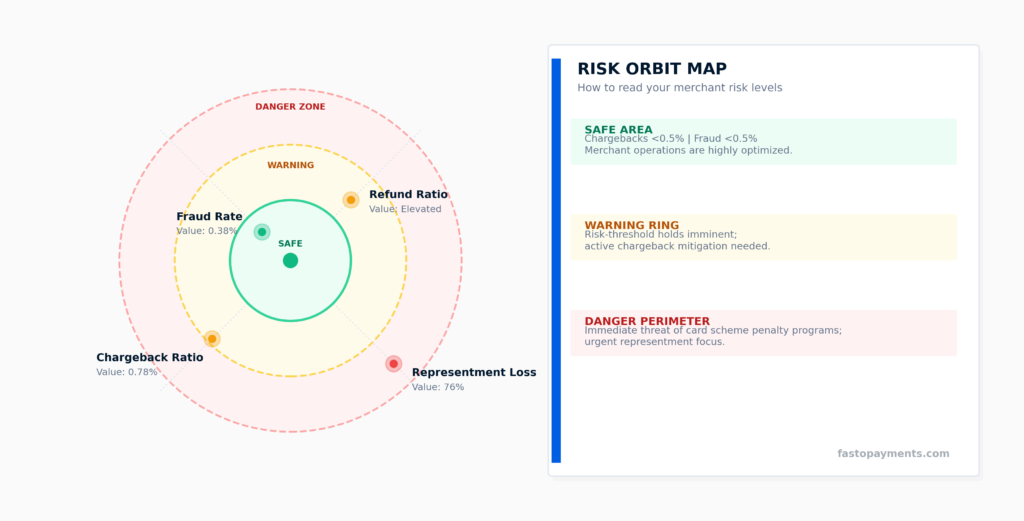
Maintaining pre-dispute alerts through services like Ethoca or Verifi is essential. Timely responses to Visa and Mastercard disputes and strong representment win rates signal a merchant who takes the process seriously. Recommended cadence: weekly internal reporting plus monthly formal reviews with your Fasto account manager. The gap between your ratio and the scheme thresholds is your safety margin, so build a buffer and protect it.
Chargeback Compliance: The Foundation Layer
Chargeback compliance is the foundation of the Compounding Compliance Curve. Full stop. For adult, CBD, nutra, gaming, crypto, and vape merchants, this is where the curve starts.
The main elements:
- Clear billing descriptors so cardholders recognise charges (especially critical for discreet billing in adult verticals)
- Responsive customer support with documented SLAs
- Fair refund policies that are easy to find and understand
- Strong customer communication flows, including order confirmations, shipping updates, and renewal reminders
- 3D Secure on online payments, which can lower chargeback rates on card-not-present transactions
Modern tools make this manageable. Real-time alerts, chargeback dashboards, and pre-chargeback resolution services let merchants act before ratios cross scheme limits. Fasto builds fraud and chargeback prevention logic into its gateway, so merchants can adjust rules without heavy development work.
Think of each avoided chargeback as a tiny deposit on your curve. Each unmanaged dispute is a withdrawal that slows the compounding. Over twelve months, those micro-decisions add up to dramatically different outcomes.
Scenario A: The Bare-Minimum Merchant (Flat Line)

Meet Alex.
He runs a global adult content platform. Traffic is growing. Revenue looks healthy. Alex spends most of his time on marketing and content acquisition. Compliance? That is what the payment provider handles, right?
Alex did bare-minimum KYC at onboarding and has not updated his documentation since. His billing descriptors are vague. His support inbox gets checked twice a week. When chargebacks arrive, his team responds only after the PSP sends a warning. He has no automated fraud rules and no pre-chargeback alert service.
The results are predictable. Chargeback ratios hover between 1.1% and 1.4%. He receives occasional scheme alerts. Fines start to accumulate. His fees stay at the premium he was quoted on day one. Reserves stay at 10%. Settlement stays weekly. When a new affiliate campaign drives a traffic spike, chargebacks surge to 1.8% and the acquirer sends a termination warning.
Alex spends more time tweaking banner images than reading scheme rules. His curve stays flat. Worse, one more bad month and he risks landing on the MATCH list, which would make getting any merchant account a nightmare for the next five years.
Scenario B: The Compounding Merchant (Upward Curve)

Meet Sara.
She runs a CBD and nutraceutical subscription brand. From day one, Sara treats compliance like a revenue project, not an afterthought.
She works with Fasto to put structured processes in place: a KYC folder that is always current, robust AML checks, card scheme rule training for her support staff, and AI-powered fraud prevention tools, alongside automated chargeback alerts via Ethoca. She reviews her risk dashboard weekly.
The timeline:
- Months 1 to 3: Chargebacks stabilise under 0.7%. Sara fixes descriptor clarity, adds renewal reminder emails, and tightens fraud thresholds for high-risk geographies.
- Month 6: Her data is presented to the acquirer. A modest fee reduction follows, from 5.5% to 4.8%.
- Month 9: Settlement speed improves from weekly to T+3. Cash flow noticeably better.
- Month 12: Rolling reserve drops from 10% to 5%, releasing significant working capital.
When a large influencer campaign is planned, Sara notifies Fasto two weeks ahead. Fraud thresholds are temporarily adjusted and monitoring is increased. The campaign goes well, with no chargeback spike.
Sara’s upward curve gives her better cash flow and stronger negotiating power, which she reinvests into marketing and product. Growth feeds compliance, which feeds better terms, which enables more growth. That is the compounding loop.
⚠ VERIFY BEFORE PUBLISHING — Alex and Sara are illustrative composites. The specific figures (fee drops, reserve reductions, timelines) are realistic but not drawn from a single named account. Keep them as composites, or swap in a verified anonymised Fasto case if you would rather publish a real one.
Common Mistakes That Flatten Your Curve
Even smart merchants sabotage their own curve without realising it.
- Hiding the true business model during onboarding. Banks always find out. It destroys trust instantly.
- Using mismatched descriptors or MCC codes. This triggers disputes from confused cardholders.
- Failing to monitor affiliate traffic quality. Bad affiliates bring bad customers who dispute.
- Ignoring early fraud signals from certain geographies. Small leaks become floods.
- PSP hopping whenever terms feel tough. This resets your history and makes every new bank nervous.
- Over-aggressive decline settings. Declining legitimate customers pushes them to dispute with their bank instead, which can ironically raise chargebacks even as fraud falls.
When metrics start to drift, talk to your Fasto account manager early. A quick course correction always beats waiting for a scheme letter to land in your inbox.
How To Actively Climb Your Curve
You can design your curve on purpose. Here is a practical 90-day starting plan:
- Baseline everything. Document your current chargeback ratio, fraud rate, refund rate, reserve terms, fees, and settlement speed.
- Fix the low-hanging fruit. Update billing descriptors. Clarify refund policies on your site. Set up pre-chargeback alerts.
- Implement a simple chargeback compliance policy. Assign ownership. Set a weekly review cadence.
Beyond 90 days, run monthly “risk reviews” the same way you run sales reviews. Use dashboards that show chargeback ratios, fraud rates, refund reasons, and scheme alerts, ideally powered by advanced chargeback management and fraud tools. Document every improvement, every policy change, every new tool. When renegotiation time comes, you want a clear story backed by data, not just good vibes.
⚠ VERIFY BEFORE PUBLISHING — The draft cited “Industry data from 2026” (cybinenterprises.com): iGaming averaging 1.5%–3% chargebacks and adult entertainment 1%–2%. I kept the claim but attributed it to the source rather than stating it as fact. Confirm you are happy with that source’s reliability before publishing, or replace with a stronger citation.
For context, one 2026 industry source puts average chargeback rates at roughly 1.5% to 3% for iGaming and 1% to 2% for adult entertainment. Beating those averages makes you a preferred merchant in any acquirer’s portfolio.
Fasto’s Role In Your Curve: What We Actually Do
Fasto is a B2B high-risk PSP that sits between merchants and acquiring banks. We are not a bank. We are the partner that helps you build the story banks want to hear.
Core services relevant to the Compounding Compliance Curve:
- Risk-based onboarding tailored to your vertical
- Tailored fraud rules and prevention tools, adjusted as your business evolves
- Chargeback management and protection services
- Ongoing scheme compliance guidance, including VAMP and Mastercard ECM monitoring
- Multi-currency and cross-border support for complex payment flows
Fasto supports adult entertainment, CBD and nutraceuticals, online gaming, forex, travel, and crypto payments with specialised high-risk merchant account solutions. We use internal risk scoring and merchant performance data to advocate for better terms once you have built enough clean history. Integration is available via API, plugins, and EU/UK POS or mPOS devices.
Aligning Compliance With Growth And Marketing
Growth and compliance should not be in conflict. Think of them as offence and defence on the same team. You need both to win.
Align your marketing calendar with your compliance planning. Before a large campaign or influencer push, pre-check your fraud rules, adjust monitoring thresholds, and brief your support team. If you are a crypto platform launching a new token feature, coordinate with Fasto to adjust fraud settings before you go public.
Consider putting compliance metrics into your board and investor reporting. Turning risk performance into a strategic asset, rather than a back-office detail, changes how your whole organisation treats it. Growth without guardrails is just a faster way to crash 🏎️.
Regulation And Enforcement: Why The Curve Matters More Now
Regulatory tightening in AML, KYC, and consumer protection is accelerating, especially in crypto, gaming, and cross-border card-not-present payments.
The EU’s MiCA regulation now sets broad compliance obligations for crypto asset service providers. The UK FCA continues to scrutinise high-risk payment flows and weak onboarding controls. And the card schemes have moved their goalposts.
Visa VAMP: On 1 April 2026, Visa’s “Excessive” merchant threshold under the Visa Acquirer Monitoring Programme dropped from 2.2% to 1.5% for the EU, UK, US, Canada, and Asia Pacific. The VAMP ratio combines fraud reports (TC40) and disputes (TC15) divided by settled card-not-present transactions. The monitoring floor is 1,500 combined events a month, and merchants over the threshold face a fee of $8 per disputed transaction. In plain terms: a merchant who sat comfortably at 1.8% under the old line is now in breach.
Mastercard ECM: Mastercard’s Excessive Chargeback Merchant programme flags a merchant at 100 or more chargebacks in a month combined with a chargeback ratio of 1.5% or higher, sustained for two consecutive months. The High Excessive tier (HECM) sits at 300 or more chargebacks and a 3% ratio. Fines escalate the longer you stay in, running from around $1,000 a month into the tens and even hundreds of thousands, and prolonged non-compliance can end in termination and a MATCH listing.
Regulators increasingly expect acquirers and PSPs to apply a risk-based approach. Merchants with strong compliance histories become more valuable partners. Those with shaky procedures will struggle even to get accounts. In this environment, the Compounding Compliance Curve is not a nice-to-have. It is a survival strategy.
Building Your Internal “Compliance Muscle”
Strong compliance is a capability inside your business. It cannot be fully outsourced to a PSP or a law firm.
Even small high-risk merchants should name one person, even part-time, who owns chargeback ratio management, fraud review, and scheme update tracking. If that person is currently also your marketing lead, fine for now. Just make it explicit, especially if you are working through the process of securing instant approval for a high-risk payment gateway.
Practical training resources include card scheme merchant guides, webinars from associations like the Electronic Transactions Association, Payments Europe events, and reviews of leading credit card security and fraud detection tools. Document your internal policies on refunds, cancellations, and support SLAs, and align them with Fasto’s dispute handling best practices.
Compliance is like going to the gym. Progress is slow at first, but it compounds quickly once the habit forms 💪.
By Vertical: Adult, Gambling, CBD/Nutra, Crypto, Vape

Each high-risk vertical has its own version of the curve.
Adult: Cardholder embarrassment drives “friendly fraud.” Customers dispute charges rather than contact support. Clear descriptors and discreet billing cut disputes dramatically, especially when paired with a specialised adult merchant account and payment gateway. Card scheme content rules add an extra compliance layer.
Gambling and gaming: Responsible gaming rules, withdrawal transparency, and spending limits are critical, and AML expectations are heightened. Watertight age verification and monitoring for problem-betting patterns are non-negotiable, as are reliable global mass payout solutions for high-risk merchants to handle winnings and affiliate commissions.
CBD and nutraceuticals: Health claims and marketing rules create exposure. Subscription billing transparency is essential, and implementing 3D Secure combined with chargeback protection can significantly reduce fraud-driven disputes. Refunds for perceived efficacy issues should be handled gracefully, not fought.
Crypto: AML and KYC intensity is the highest of any vertical under MiCA. Transaction monitoring requirements are comprehensive, and strict front-door controls greatly improve long-term risk metrics; for some operators, specialised chargeback insurance for high-risk businesses can be part of the overall risk-transfer strategy.
Vape: Age verification and geo-restrictions are non-negotiable, and rules vary by country, so compliance must be localised. Merchants who get this right early build a strong foundation and are better positioned to secure high-risk merchant accounts in regulated markets like the UK.
How Long Until You See Results?
The curve is powerful but not instant. Set expectations correctly.
- 3 months: Early signals improve. Chargeback trend stabilises. The acquirer notices.
- 6 months: First minor fee or limit changes become negotiable.
- 9 to 12 months: Meaningful reserve and settlement improvements, depending on vertical and starting point.
Merchants with existing negative history need longer to repair trust. Think of it like rebuilding a credit score after a default. The data needs time to accumulate, and every month of delay pushes back the point where compounding accelerates. Patience plus aggressive execution is the formula.
Overlooked Data That Strengthens Your Case
Many merchants already sit on useful data they never present to PSPs or acquirers.
- Customer satisfaction scores and NPS
- Delivery time statistics and proof of fulfilment
- Refund reasons categorised by issue type
- Fraud rule hit-rate logs (how many orders flagged or declined)
- Representment win rates on disputed chargebacks
Package this into a short memo or slide pack before scheduled reviews, and coordinate with your Fasto account manager ahead of renewal dates. Keep a simple “risk narrative” document updated quarterly that tracks every improvement and its impact on your KPIs.
Putting It All Together: Your Next 12 Months

- Days 1 to 90: Diagnose and stabilise. Baseline all risk metrics. Fix descriptors, refund policies, and support SLAs. Deploy pre-chargeback alerts.
- Months 3 to 6: Optimise. Tighten fraud rules. Monitor weekly. Document your improvements.
- Months 6 to 12: Negotiate and leverage. Present your data to Fasto and the acquirer. Push for fee reductions, higher limits, faster settlement, and reserve reductions.
Write down specific numeric targets: chargeback ratio below 0.5%, fraud rate declining month over month, reserve goal of 5% within twelve months. Then link them to calendar reminders. Merchants who start now will be in a far stronger position by the time their next peak season arrives.
FAQ
How quickly can I improve my chargeback compliance if my ratios are already above scheme thresholds?
Realistically, 3 to 6 months of focused work can bring ratios below thresholds. Immediate steps include tightening fraud rules, clarifying billing descriptors, improving support response times, and activating pre-chargeback alerts. Fasto can help design an emergency stabilisation plan. Banks respond well to a clear downward trend even before thresholds are fully met. The longer high ratios persist, the harder later improvements become.
Does using multiple PSPs or acquirers help or hurt my curve?
Both, if you do it carelessly. Spreading thin volume across many providers makes it harder to show any single bank a strong history, which weakens your negotiating position. But you should never run your whole business on a single processing route either, because one freeze can take you offline entirely. The answer is redundancy with concentration: keep at least two independent rails for resilience, while putting enough volume and clean performance through each to build a track record worth negotiating on. Fasto works with merchants on multi-PSP setups and encourages transparent volume and risk reporting across them.
Can very small merchants benefit, or is this only for large operators?
Even small merchants benefit. Faster settlements and protection from sudden account closures matter at any scale. Absolute fee reductions may be smaller in cash terms, but the percentage impact is identical. Starting good habits while small makes later scaling much easier and improves your access to top-tier acquirers. Fasto supports emerging high-risk merchants in building a credible track record from early on.
What happens to my curve if I have one bad month?
One bad month does not erase years of good history, but how you respond matters enormously. Reach out to Fasto immediately, communicate transparently with affected customers, and consider temporary refund-policy changes to defuse disputes. Documented corrective action reassures banks that the spike is a one-off, not a new normal. The curve bends but does not break if you handle it well.
How is Fasto different from mainstream PSPs for chargeback compliance?
Fasto specialises in high-risk verticals. We offer tailored risk and chargeback tools and we understand scheme and banking expectations in sectors like adult, gambling, CBD, crypto, and vape. Mainstream PSPs tend to offboard high-risk merchants quickly once issues arise. Fasto focuses on remediation, data storytelling, and moving merchants up their Compounding Compliance Curve.
Start Climbing Your Curve With Fasto
Compliance is not a cost. It is an investment. And like any good investment, it compounds.
Audit where you sit on your Compounding Compliance Curve today. Bring your last 6 to 12 months of processing metrics to a conversation with Fasto, and we will show you exactly where you stand and what it takes to move up.
Want to work with us?
The best time to start compounding was last year. The second-best time is now 🚀.