
Running a vape shop across online and physical stores is brilliant for revenue. Less brilliant when your cash register thinks you have 12 bottles of mango nic salt and your website thinks you have none. Or the other way round. 😬
This guide walks UK and EU vape retailers through what a modern vape shop POS system actually needs to do, why syncing online and offline operations matters more than most owners realise, and how to keep payments flowing when your industry is labelled “high-risk.”
Key Takeaways
A successful vape store needs a POS system that unifies in-store and online stock into a single source of truth. That means real-time inventory management, a shared customer database, unified reporting, and card-present plus ecommerce payments running on the same merchant setup. Built-in age verification is essential for any vape POS operating in the UK and EU.
What “good” looks like in practice:
One stock count across your till and your ecommerce store, updated the moment any sale happens
Sales reports covering VAT, margins, and multiple locations
Age verification at both touchpoints, with logged audit trails
A payment processor that explicitly supports vape and will not freeze your account on a Tuesday afternoon
The typical mess when systems are separate?
Overselling popular flavours, stock drift between channels, mismatched VAT figures, chargebacks from cancelled orders, and payment providers suddenly deciding nicotine is not their thing. This article is written for UK and EU vape retailers already trading. Think: busy Saturday in-store while a flash sale runs online. That kind of chaos.
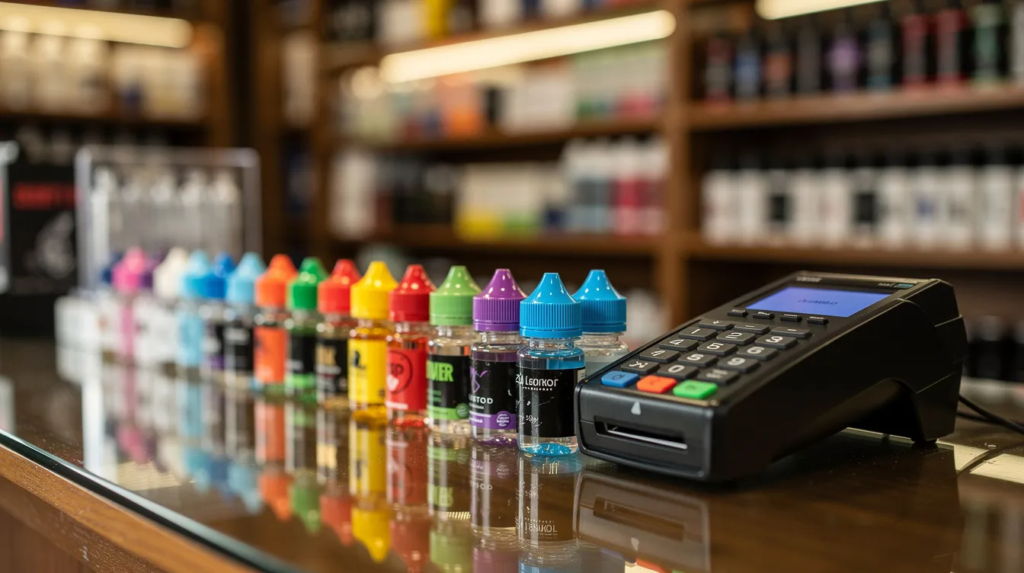
What a vape shop POS actually needs to do (the omnichannel checklist)
Let’s get one thing straight.
A vape shop POS is not just a fancy till that goes “beep.” It is the brain that keeps your shelves, your online store, and your payment flows talking to each other. Without that central brain, you are running two businesses and pretending they are one.
Vape shops often manage hundreds of SKUs across different flavours and nicotine strengths. Your EPOS needs to handle that complexity. Core retail functions tailored to vape include:
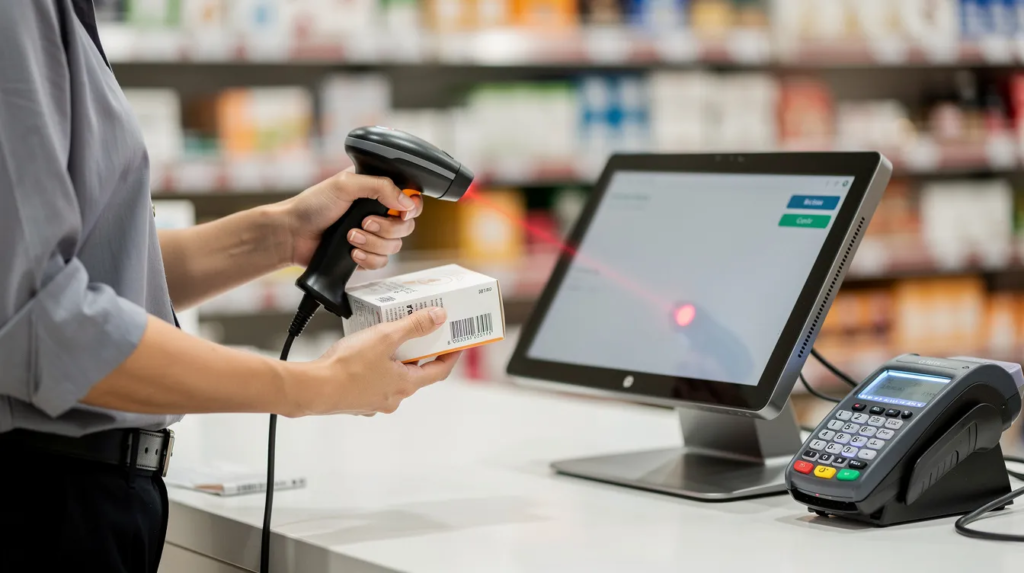
Barcode scanning for e-liquids, coils, kits, and pod devices, which speeds up checkout and keeps stock counts accurate
Quick product search by flavour, strength, VG/PG ratio, and brand
Split payments, refunds, discounts, and cash management
Quantity limits on age-restricted lines where you want them
Every payment type your customers use, from cash to Apple Pay
Omnichannel retail in plain English means one system covering card-present and online payments, click-and-collect, local delivery, and in-store reservations. Your POS should give customers flexibility in how they pay and collect, and give you one place to see all of it.
The must-have checklist:
Feature | Why it matters |
|---|---|
Advanced inventory management | Track stock across variants, bundles, and batches |
Ecommerce integration | Online and in-store stock sync in real time |
Loyalty integration | Single customer record, both channels |
Built-in age verification | Prompts, logging, compliance |
Reporting | VAT, margin, multi-location, staff performance |
Tick those boxes and you have a POS that actually works for vape. ✅
The core problem: when tills and websites do not talk to each other
Here is a story every vape shop owner has lived.
Your best-selling 10ml nic salt goes on a flash sale online Friday evening. By Saturday morning it is sold out on the website. But your till still shows 15 units because nobody updated it. Staff sell in store from the same stock all day.
Monday morning? Eight orders to refund, three angry emails, and a chargeback from someone who paid by card online. Lovely 🙃
This is “stock drift.” Your website says 12 bottles, your till says 8, your actual shelf has 5 because of miscounts, damages, and unrecorded swaps of nicotine strength. Separate systems mean duplicated work. Staff update stock twice. Customer details get entered in two places. Daily takings from the POS get reconciled against ecommerce payouts in spreadsheets. Small business owners do not have time for that.
Compliance headaches stack up too. Different age verification steps on your website versus in-store. Missing records when Trading Standards ask for proof. Confusion over which system holds the accurate transaction logs.
Then there is the payment risk. Your online orders go through a high-risk payment gateway, but your in-store card machine runs through a mainstream acquirer. That acquirer later decides it will not support vape. Your till becomes an expensive calculator while your website still works. High-risk businesses often end up here after rejections by mainstream processors like PayPal, Stripe, or Square, or hit the limits of built-in options when they try to run vape shops on platforms like Shopify with dedicated high-risk payment processors.
Sound familiar?
Real-time vape inventory management across till and website
Real-time inventory management means one stock number per SKU, updated every time you sell a pod, bottle, or device, no matter the channel. A sale at the counter instantly reduces website availability, and an online order reduces what staff see on the EPOS screen. One number, always current.
Vape-specific challenges make this harder than regular retail. You are dealing with many variants (flavour, nicotine strength, VG/PG, brand), small pack sizes, kits versus components, and occasional bundles. A good system manages thousands of these without falling over.
Features that make inventory management painless:
Low-stock alerts on your bestsellers, so you reorder before you run dry
Automated purchase orders to suppliers, which save hours of manual work
Minimum restock levels with email alerts
Stock received via barcode scanning, which cuts manual entry errors
Audit trails for adjustments (damages, returns, strength swaps)
Multi-store tracking so one catalogue covers every location
This level of stock control supports margins directly. Less dead stock, fewer rush purchase orders, fewer refunds from overselling, and better cash flow planning before peaks like Christmas or the January “quit smoking” rush. Cloud-based access lets you check how things are moving even when you are not in the shop.
The disposables ban and why your stock data had to keep up
Since 1 June 2025, it has been illegal to sell or supply single-use disposable vapes anywhere in the UK, including non-nicotine versions. Any vape legally on sale now has to be rechargeable and refillable, with a coil or pod that can be replaced. This was not just a shelf clear-out. It was a stock-data event.
Retailers had to pull every banned SKU from both the shop floor and the website, and make sure the two agreed. A disposable that quietly stayed “in stock” online after the deadline is exactly the kind of gap a unified POS closes and a pair of disconnected systems leaves open. If you ran separate tools through that transition, you already know how fiddly it was to be certain both were clean.
The wider point holds for whatever comes next. Regulation in this industry moves, and your systems have to move with it. When a product category changes status, you want to retire it once, in one place, and trust that both channels reflect it.
Age verification in-store and online (UK/EU compliance)
In the UK, it is illegal to sell vaping products to anyone under 18, and that includes non-nicotine vapes. Trading Standards carry out test purchases both in retail stores and online, so you need to prove “reasonable steps” at both touchpoints. Online sellers are expected to run proper age verification on every order, not just a tick box, and the penalties for getting it wrong run to fines and, at the serious end, loss of your ability to sell restricted products.
In-store: The standard approach is a “Challenge 25” policy. Staff challenge anyone who looks under 25 to show ID. Acceptable IDs include a passport, a photocard driving licence, and PASS-hologram proof-of-age cards. Your POS should log who approved the check, the time, and the ID type, and keep a refusal log for sales you declined. That record is your defence if you are ever challenged.
Online: Self-declaration tick boxes alone are not enough. Third-party age verification providers such as Luciditi or Yoti run document and, where needed, face checks at checkout. Store the verification status against the customer profile so returning regulars do not repeat the process every order.
The big benefit of unified age verification? One customer record showing verified status, usable across both channels. Staff do not repeat checks, and you have a single audit trail rather than two half-complete ones. If you sell across borders, per-jurisdiction rules in your POS let you enforce the right check for the right market.
Heads-up on wider rules: the Tobacco and Vapes Act brought in tougher enforcement and a retailer licensing scheme for tobacco, vape, and nicotine products, and a new duty on e-liquid lands in October 2026. Both touch your systems (licensing records, repricing, duty tracking), so it is worth keeping an eye on the detail as it rolls out.
The payments layer: why vape is high-risk and what that means for POS
Vape is classified as high-risk by the card schemes and acquirers. Higher chargeback rates, tighter scheme rules, and frequent policy changes from mainstream acquirers make high-risk payment processing the reality for every vape business, online and in-store alike, so UK merchants in particular should understand the best high-risk merchant account providers in the UK and how they underwrite vape.
Common pain points for UK and EU vape merchants:
Accounts frozen for “prohibited nicotine sales” with little or no warning
Rolling reserves held back against future chargebacks, which ties up cash flow
Higher processing rates than a mainstream retailer would pay
Per-dispute chargeback fees that add up fast if disputes are not managed
Card-scheme registration requirements that come with their own annual cost
Here is the line that matters most. A vape POS is only as reliable as the merchant account underneath it. If the processor behind your card terminal shuts you down, your till stops taking cards, and if that processor is separate from the one behind your website, you can lose one channel while the other keeps running. Or lose both. The fix is not a cleverer till. It is a payment setup built for vape from the start, covering both channels on one relationship.
High-risk merchants also need proper fraud prevention and chargeback protection. Most POS platforms integrate with “major” payment providers, but “major” does not always mean “vape-friendly.” The gateway and the acquirer both have to support your product category, or none of the integration matters, so it is worth comparing high-risk merchant account providers in the US, UK, and Europe before you commit. 😅
Designing an omnichannel vape setup that stays live
Design your setup “from the receipt backwards.” Start with how the customer pays and gets their order. Then work back through stock, till, and website.
Common flows UK and EU vape shops use:
In-store only with a solid POS and card terminal
In-store plus click-and-collect where customers buy online and pick up
Full ecommerce with nationwide delivery and online orders
Multi-branch setups sharing one catalogue across locations
To link POS and ecommerce, look for native integration modules, APIs, or middle-layer connectors that sync products, prices, promotions, and stock in near real time; robust payment APIs for high-risk merchants also matter so your vape store can route transactions reliably. Some platforms include their own website templates so you can sell online without hiring a web agency, and let you add new channels as you grow.
Key configuration decisions:
Which system is the “master” for product data (usually the POS)
How often to sync stock (near real-time is ideal for a busy vape shop)
How to handle reserved stock for open baskets
How to map shipping, collection, and local delivery options
Resilience matters. Your POS needs an offline mode for brief internet drops, so you can still sell in store without panicking, then sync back once the connection returns. Do not let both channels depend on a single fragile integration point, and make sure your overall payment processing setup supports both local and alternative methods your customers expect. Instant visibility across channels keeps staff confident and customers coming back.
Using data and loyalty tools to boost profits (without being creepy)
Once stock and payments are unified, you can actually trust your data. That is when things get interesting for your bottom line.
Core reporting to expect from your vape shop POS system, especially if you are using a global payment gateway for local and alternative methods:
Bestsellers by flavour and strength
Seasonal sales patterns over the year
Margin by product type (pods, liquids, hardware, accessories)
Price analysis and staff performance tracking
Stock movement trends you can actually act on
Loyalty schemes lift repeat business by rewarding purchase history, and they can be simple. Points per pound, punch-card style rewards (“every 10th bottle free”), or member-only offers. Tie them to a single customer record used both online and in-store, so the same regular is recognised whichever way they shop, and plug in mass payout solutions for high-risk merchants if you also run affiliate programmes or pay creators.
A couple of practical examples: send a “favourite flavour back in stock” email to regulars, or offer early access to new kit launches. These keep repeat business flowing without being intrusive. Just keep marketing opt-ins clear and GDPR compliant. Collect only what you need, store age verification status securely, and respect privacy. Nobody wants to feel surveilled for buying a bottle of strawberry shortcake 🍓
How Fasto fits into the picture (the short version)
This is not a sales pitch. Just context on where Fasto sits.
Fasto specialises in high-risk merchant accounts for regulated industries like vape, CBD, and adult. We set up payment processing with those risks in mind from day one, rather than bolting them on and hoping, using the same global payment gateway for local and alternative methods and payment processing best practices we recommend to high-risk merchants generally.
For UK and EU vape retailers, Fasto provides card-present and online payment processing on one relationship, multi-currency support where you sell across borders, and fraud and chargeback tools that work alongside your existing POS and ecommerce platforms, backed by 24/7 support and quick assistance.
You can usually keep your preferred POS or EPOS and plug Fasto in at the gateway or acquiring layer. The point is continuity: both your till and your website keep taking payments, on a setup that will not suddenly decide nicotine is a problem. You focus on running a good vape shop, not chasing acquirers.
Practical steps to choose and implement your vape shop POS system
Time for the checklist part. Here is how a UK or EU vape retailer goes from messy separate systems to a unified setup.
Step 1: Map your current tools. List your till, website platform, payment processors, and any other tools you use. Note every pain point: overselling, reporting mess, duplicated age checks, offline moments that break the shop.
Step 2: Define must-haves. Advanced inventory management, ecommerce integration, age verification, and high-risk payment support are non-negotiable. Understanding the key factors for instant approval on high-risk gateways at this stage also helps you avoid nasty surprises. Nice-to-haves might include stock forecasting or automated reordering.
Step 3: Evaluate without brand bias. Judge vendors on the questions that actually decide it, not the marketing; ongoing reading around high-risk payment trends and risk management will keep your criteria sharp as rules evolve.
Do you explicitly support vape and nicotine sales, in writing, the way specialist high-risk payment processing for nightlife and adult venues does for its sectors?
Do you integrate with high-risk payment processors, or lock me into your own?
Can I keep my existing merchant account if I want to?
How does online and in-store stock sync, and how fast?
What happens to card payments when the internet drops?
How is age verification handled and logged, on both channels?
Any vendor who gets cagey on the vape question or the payments question is telling you something. Believe them.
Step 4: Roll out sensibly. Migrate stock data. Test online and in-store sync with a small product group first. Train staff on the new workflows. Run parallel reports for a few weeks to compare accuracy before you go all-in.
Step 5: Build relationships. Your POS vendor and payment provider should be partners, not just suppliers. When regulations change or you open a second shop, the setup should scale rather than collapse, and shared payment API roadmaps for high-risk merchants are a good sign they are planning ahead. Getting this right from the start is what keeps both channels live.
FAQ
These questions cover edge cases not fully addressed above. Answers are focused on UK and EU vape retailers.
Can I run my vape shop on a generic retail POS if I keep payments separate?
Technically yes. You can use a generic POS for stock and a separate high-risk processor for payments. But you end up with two sets of reports, harder reconciliation, and more points of failure. If you go this route, make sure the generic POS integrates cleanly with your chosen high-risk gateway or global payment gateway for local and alternative methods so card-present and online payments both flow into the same accounting structure.
Do I really need online age verification if my couriers check ID on delivery?
Relying only on courier checks is risky. Orders can still be placed by under-18s, and regulators expect verification at the point of sale online, not just at the door. Combine a proper online age verification tool at checkout with delivery ID checks to demonstrate strong due diligence if you are ever challenged, and confirm with your processor’s support team how they expect you to document this.
How often should my POS and ecommerce sync stock levels?
For busy vape shops with popular lines, near real-time sync is ideal, with updates pushed the moment a sale happens in either channel. At minimum, sync every few minutes. Nightly batch syncs alone are not enough for high-volume or multi-branch vape retailers.
What happens if my internet goes down in-store?
Some POS systems offer an offline mode for card-present payments and basic sales recording, then sync once the connection returns. Confirm with both your POS vendor and your payment processor how offline transactions are handled, what limits apply, and how long you can safely operate that way.
Is it worth adding loyalty if most of my business is walk-in trade?
Yes. Walk-in vape customers are often creatures of habit. Simple points or “every 10th bottle free” offers turn casual buyers into loyal regulars. Loyalty tools tied to your POS capture customer details legally, support marketing with consent, and usually pay for themselves in repeat business.