Key Takeaways
- The Two-Rail Rule is simple: never run your business on a single processing route. Always keep at least two independent, live rails.
- In high-risk, a frozen processor is not an inconvenience. It is your entire revenue going to zero, often with no warning and with your balance held.
- A real second rail means a separate acquirer and a separate bank. A second MID under the same bank is not redundancy. If that bank cuts you off, both MIDs die together.
- Redundancy is not paranoia. It is how serious operators scale without betting the whole business on one banking relationship.
- This guide is for adult, gambling, CBD, nutra, crypto, and vape merchants who cannot afford to go offline, and who need reliable high-risk merchant account solutions that will not leave them stranded on a single rail.
One Email From Zero
Here is the nightmare every high-risk merchant knows.
You wake up, check your dashboard, and payments are declining. Every single one. You log in to your processor and there it is: account under review. Funds on hold.
No timeline.
Your revenue just went to zero. Not down. Zero. 😓
In most industries, losing a processor is a headache. You find a new one, you move over, you lose a few days. In high-risk, it can kill the business. Mainstream processors drop high-risk accounts all the time, often with no warning and no way to appeal. And while your money is stuck in a hold you cannot touch, the bills keep coming.
Payroll keeps coming. Ad spend keeps coming.
There is one rule that prevents this. It is not clever. It is not new. But almost nobody follows it until after they have been burned once.
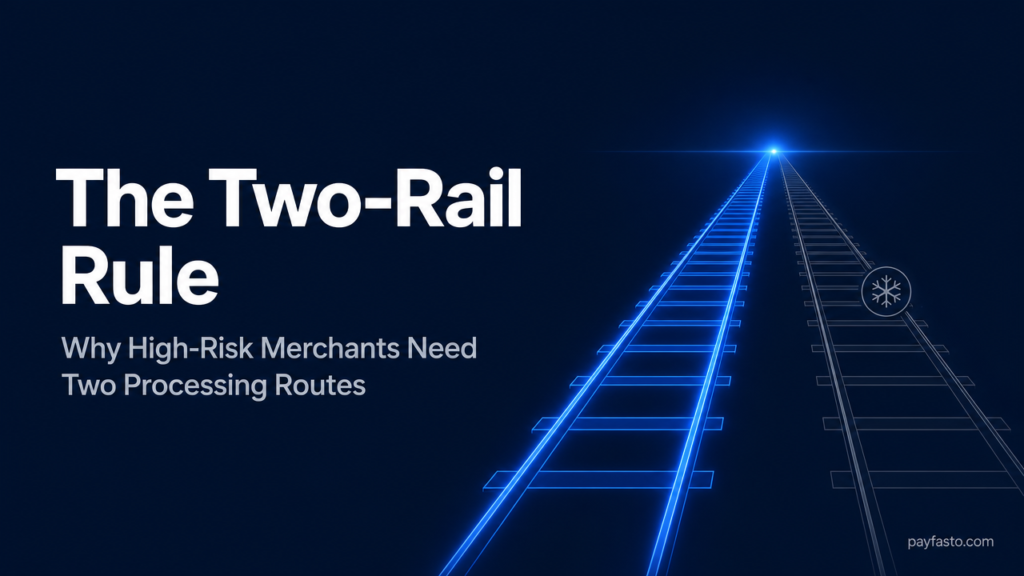
We call it the Two-Rail Rule.
What Is The Two-Rail Rule?
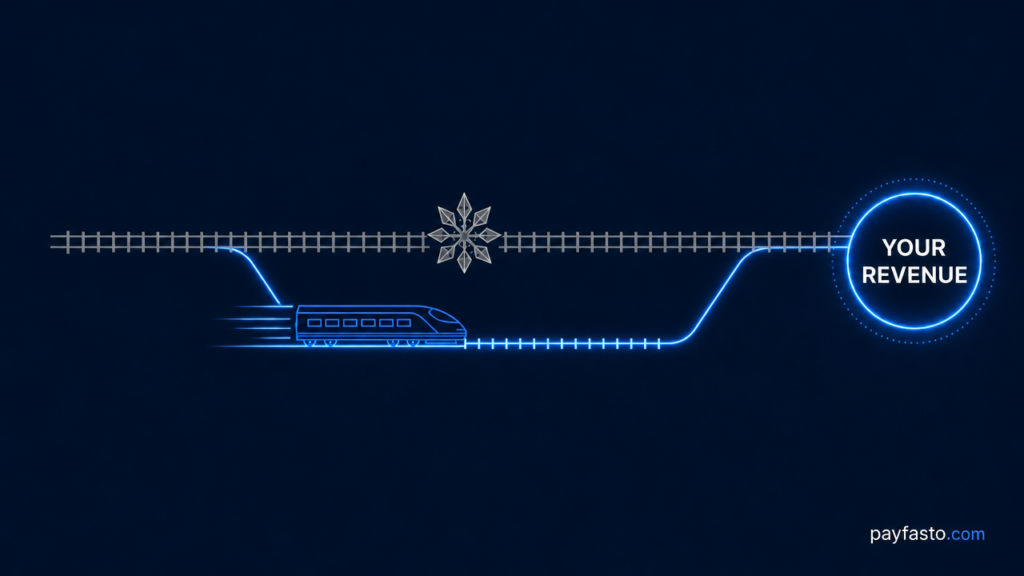
The Two-Rail Rule: never operate your business on a single payment processing route. Always maintain at least two independent, active rails, so that if one processor or bank freezes you, revenue keeps flowing through the other.
The one-liner worth remembering: in high-risk payments, one rail is no rail.
A “rail” is just the route your money takes to get from your customer’s card into your bank account. It runs through a processor, an acquiring bank, and the card networks like Visa and Mastercard. When someone says they “got shut down,” usually one link in that chain broke. And because they only had one chain, everything stopped at once.
The Two-Rail Rule means you treat the second route as essential, not as something you sort out later. Think of a plane with two engines. You do not add the second engine after the first one fails. You fly with both from the start.
Why Single-Processor Setups Fail In High-Risk
Every business depends on being able to take payments. But high-risk merchants face a risk that normal shops do not: your processor might drop you not because you did anything wrong, but simply because of the industry you are in.
Here is what takes a single-rail merchant offline:
- They drop you with no warning. The processor decides your industry is no longer worth the risk and closes your account. This can happen even when your numbers are clean. It can also be triggered by fraud, or by the category code attached to your account.
- Their bank pulls out. The bank behind your processor decides to stop serving high-risk, and every merchant under that bank loses processing at the same time. You did nothing. You still go dark.
- One bad month on chargebacks. A single spike pushes you over a card network limit, and the processor cuts you off rather than deal with the risk, which is why strong payment processing risk management practices matter just as much as picking the right processors.
- A sales spike scares them. A campaign works too well, your volume jumps, and the risk team freezes the account to check what is going on.
- They hold more of your money. The processor raises your reserve, and a chunk of your cash is suddenly locked away.
Notice how few of these are your fault. Most are just how the system works. If you run on one rail, you are betting your whole business on a single risk team you have never even met.
A Real Second Rail vs A Fake One
This is where a lot of merchants who think they are safe are not. They add a second merchant account and assume they are covered. Then the freeze hits and both accounts die on the same day. Here is the difference.
A fake second rail
This is a second account (a second MID) opened with the same processor or the same bank. It feels like a backup. It is not. If that bank drops high-risk or the processor closes your business, every account under it goes down together. It is like having two doors into the same room. Lock the room and both doors are useless.
A real second rail
This is a fully separate route: a different processor, a different bank, with nothing shared between them. When one fails, the other has no connection to it, so it keeps running. That is the whole point. If your two rails share a bank, they are not really two rails.
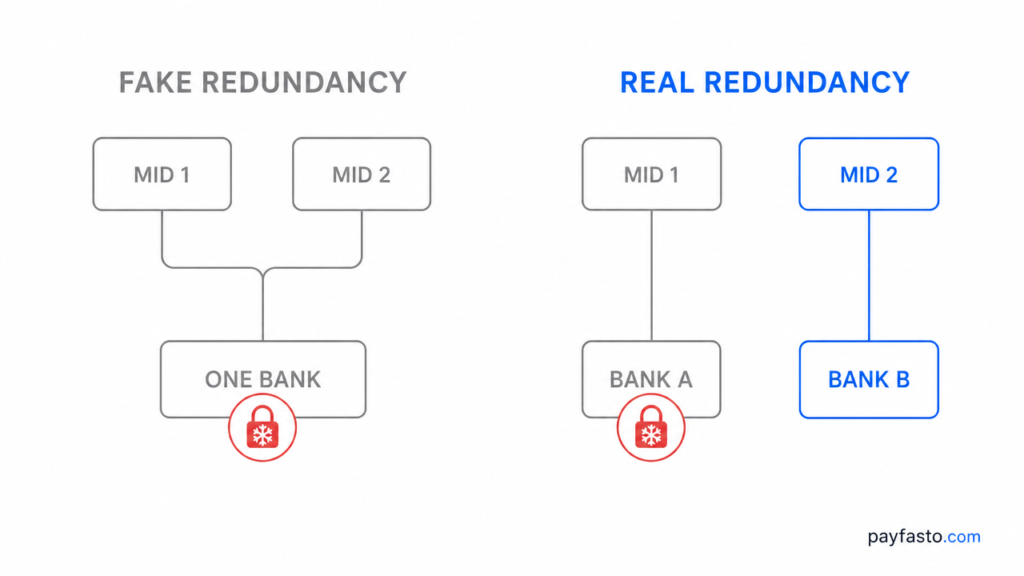
When you set up a second rail, ask yourself one question: if my main processor and its bank vanished tomorrow, would this still take a payment? If the honest answer is no, you do not have a second rail. You have one rail with extra steps.
How To Split Volume Across Two Rails
Having two rails is step one.
Actually using both is step two. A second rail that has never taken a real payment is not proven. And an untested rail can fail at the worst moment, because it has no history with its own bank yet.
A few workable approaches:
- Primary and warm standby. Route most volume through rail one, but send a steady, meaningful share through rail two so it stays active and builds its own history. Never let the backup go cold.
- Split by product or country. Send one product, currency, or region through each rail, especially if you are using a global payment gateway for local and alternative methods. It keeps both live in a natural way.
- Split by percentage. Send a set share down each rail (say 70/30) and adjust as each one’s limits grow.
There is a bonus here too.
Each rail builds up its own clean track record, and over time that earns each one better terms. So splitting your volume is not just a safety net. It is how you build trust with two banks at the same time.
Learn more about compounding compliance curve.
How To Fail Over Fast When A Rail Goes Down
The real value of a second rail shows up in the first hour of a freeze. If switching over is smooth, a freeze is just annoying. If it is not, it is still a disaster, only a bit smaller. Get ready before you need it.
- Know how to switch in advance. Your checkout should be able to send payments to rail two without a developer scrambling at 2am. Work out how you flip the switch before the freeze, not during it.
- Keep rail two live and funded. A backup that needs re-verification when you activate it is not a backup. Keep it warm, keep its KYC current.
- Have both sets of credentials and contacts ready. Know your account manager on each rail by name. In a freeze, a human who picks up the phone is worth more than any dashboard.
- Tell customers quickly. If some payments fail during the switch, a fast, honest message stops a confused customer from filing a chargeback, which would only hurt your numbers on the rail you just moved to. A clear billing descriptor on the new rail helps too, since it stops “I don’t recognise this charge” disputes.
Practise it.
Once a quarter, run a real payment through rail two and check the whole path works start to finish, ideally using well-documented payment APIs built for high-risk merchants so switching routes is simple and predictable.
A backup you have never tested is a hope, not a plan.
Reserves And Cash Flow Across Two Rails
Running two rails changes how you handle cash. Each processor may hold its own reserve, so the money that is held back is spread across two of them. That is not a problem, especially if you pair intake rails with global mass payout solutions for high-risk merchants. It means your cash is not all sitting in one place.
The upside: if one processor freezes and holds your balance, the other is still paying you out. You keep cash coming in even in a bad week. The thing to plan for: two reserves means two payout schedules and two sets of terms. Some processors also hold your money for up to a week before paying out, so know both schedules and a hold on one rail will never catch you off guard.
As each rail builds a clean record, you can ask for lower reserves on both. So two rails do more than protect your income. Over time they give you two positions to negotiate from instead of one.
Keep Both Processors In The Loop
A quiet merchant makes a risk team nervous. A merchant who keeps them in the loop is one they trust. With two rails, you just do this twice, and it pays off twice.
- Warn both processors before big campaigns, launches, or busy seasons, so neither is surprised when your volume jumps.
- Share good news with both, like a lower chargeback rate. A steady, reliable track record makes a processor more comfortable, and that earns better terms on each rail.
- Do not hide the fact that you run a second rail. Reputable high-risk processors expect it and respect it. It signals a serious operator, not a flight risk.
Being transparent on both rails builds the kind of relationship that makes a risk team pick up the phone and talk to you before they freeze anything. That conversation is often the difference between a warning and a termination.
Common Two-Rail Mistakes
- Two MIDs, one bank. The classic false redundancy. One upstream failure kills both.
- A cold backup. A second rail that has never processed live volume and needs re-verification the moment you need it.
- No tested failover. Assuming the switch works without ever running a real transaction through it.
- Hiding rail two. Treating your second processor like a secret, which erodes trust if discovered.
- Waiting until after the first freeze. Setting up rail two while rail one is already frozen, when onboarding takes weeks you do not have.
How FASTO Helps You Run Two Rails
FASTO works with high-risk merchants across adult, gambling, CBD, nutra, crypto, and vape. We hold more than one banking relationship, which is a big part of how we keep merchants live. Being a strong rail, and helping you build a second one, is core to what we do, and we are consistently ranked among leading high-risk merchant account providers in the US, UK, and Europe.
- Multiple acquiring relationships so your processing does not rest on a single bank, and informed guidance on getting fast approval for high-risk payment gateways when you add or replace a rail.
- Support for running alongside another provider, because we would rather be one of your two strong rails than pretend you should only have one.
- Experience in your specific industry so setting up a second rail is quick and well informed.
- Help with splitting volume and switching over set up around how your business actually works, whether you sell online only or also need POS and mPOS payment solutions to keep in-person sales on a second rail too.
Build Your Second Rail Before You Need It
The best time to set up a second rail is while your first one is healthy. The worst time is the morning it freezes ❄️
If you are running your whole business on a single processor right now, that is the one thing worth fixing this quarter. Everything else can wait. This cannot.
Talk to FASTO about becoming one of your two rails. Send us your application and let us help you make “one email from zero” impossible.
One rail is no rail. Build the second one now.
FAQ
Isn’t running two processors more expensive and more work?
A bit more admin, yes. But the cost of a second rail is small next to the cost of going fully offline for weeks with your money frozen. Think of it as insurance you actually use every day, since both rails take real payments. For most high-risk merchants it is not a close call.
Can’t I just add a second merchant account with my current processor?
That is the most common mistake. A second MID under the same acquiring bank is not real redundancy. If that bank exits high-risk or your processor offboards you, both accounts go down together. A true second rail needs a separate acquirer and bank.
How much volume should I send through my backup rail?
Enough that it stays live and builds its own track record. A rail that has never handled real payments is untested and may fail when you switch to it. A steady small share, or one product line or region, keeps it warm and trusted by its own bank.
Will my processor be offended that I use a competitor too?
Reputable high-risk processors expect it. Redundancy is standard practice among serious operators, and hiding it does more harm than being upfront. A good processor would rather be one of your two strong rails than your single point of failure.
I’m small. Do I really need two rails yet?
Sudden freezes do not check your size first. Going offline hurts a small merchant just as much, sometimes more, because the cash buffer is thinner. Building the habit while small makes it effortless as you grow.