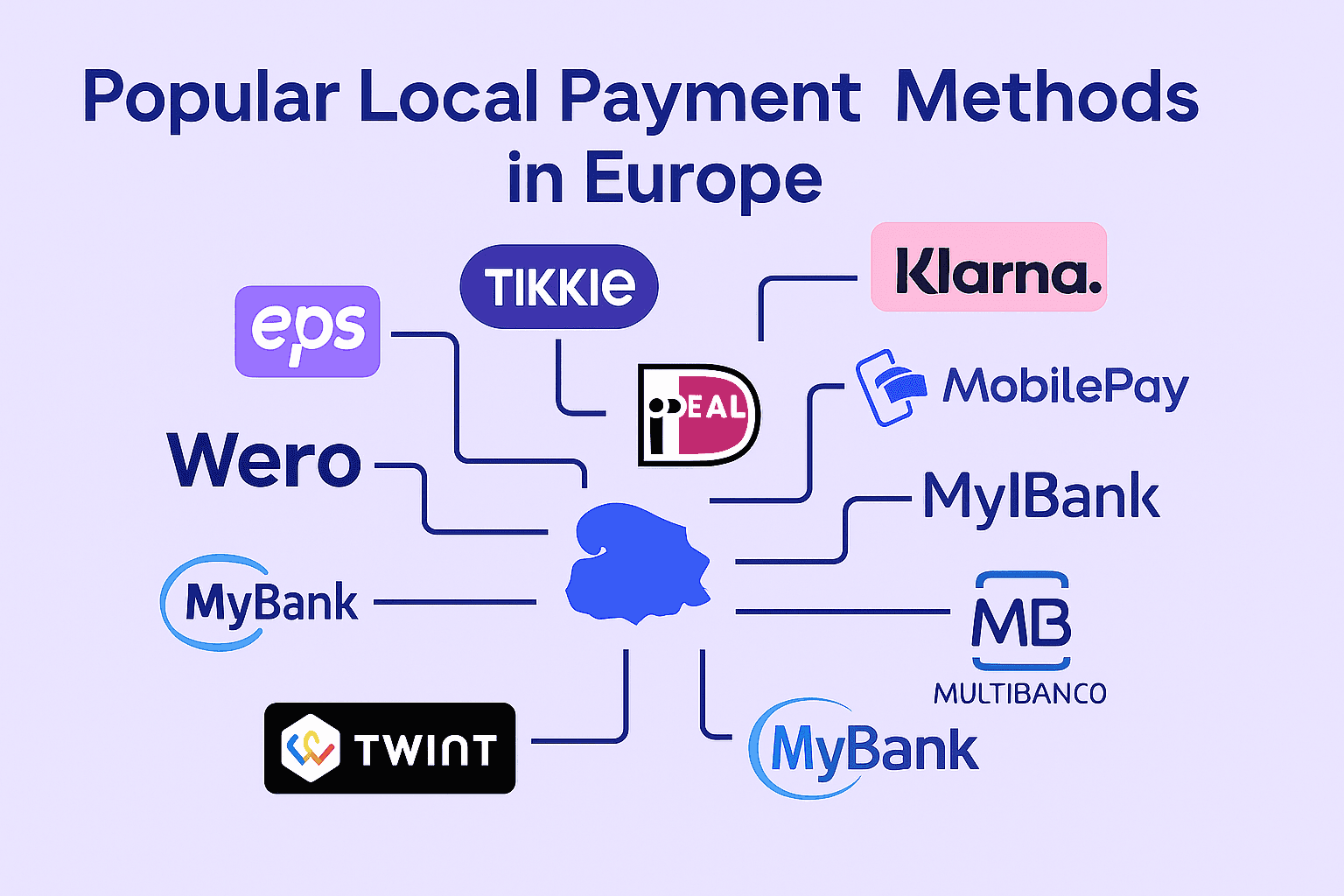
Cards work everywhere in Europe, but they are not how everyone prefers to pay. In the Netherlands shoppers look for iDEAL, in Belgium Bancontact, in Poland BLIK and in Sweden Swish. These are local payment methods: payment options built around one country’s banks and habits.
This guide explains what local payment methods are, how they differ from cards, which ones matter in each European market, and what is changing as Wero and instant payments roll out.
Key takeaways
- Local payment methods (LPMs) are payment options designed for a specific country or region, usually linked directly to the customer’s bank account or a domestic mobile app.
- Most bank-based LPMs, such as iDEAL, BLIK and Swish, have no card-style chargeback. The customer authorises each payment in their own bank, and refunds are sent by the merchant.
- The landscape is moving: iDEAL is migrating to Wero, Payconiq in Belgium is now Bancontact Pay, and Sofort no longer exists as a standalone method.
- The EU Instant Payments Regulation means euro-area banks now have to send and receive instant euro transfers, which supports faster settlement for account-to-account payments.
- Pick methods by where your customers are, whether you need recurring billing, and whether the method accepts your business type.
What are local payment methods?
A local payment method is any way to pay that is built for a particular domestic market rather than for global use. Visa and Mastercard are accepted almost everywhere. A local method usually works only in its home country, or in a handful of neighbouring ones, but in that market it is often the option customers trust most.
Local payment methods in Europe fall into a few broad types:
- Bank redirects and account-to-account (A2A) payments. The customer is sent to their bank or banking app, approves the payment, and the money moves straight from their account. Examples: iDEAL, EPS, Przelewy24.
- Mobile payment apps. The customer pays from an app connected to their bank account or card, often by phone number, QR code or a one-time code. Examples: BLIK, Swish, Vipps MobilePay, Bizum, TWINT, Wero.
- Domestic debit schemes. National card or debit brands that work alongside the international schemes. Example: Bancontact.
- Voucher and reference payments. The customer receives a reference at checkout and pays it later through online banking or at an ATM. Example: Multibanco.
- Buy now, pay later. The provider pays the merchant and the customer pays the provider, now or later. Example: Klarna.
- Direct debit. The customer signs a mandate and the merchant collects from their account. Example: SEPA Direct Debit.
Local payment methods vs cards
The biggest differences between local methods and cards are in how payments are authorised, how disputes work and what the customer can do after paying. The table below compares a typical bank-based local method with a card payment.
| Bank-based local method (e.g. iDEAL, BLIK, Swish) | Card payment | |
|---|---|---|
| How the customer pays | Approves the payment in their bank or banking app | Enters card details or uses a wallet, often with 3-D Secure |
| Where the money comes from | Directly from the customer’s bank account | From the card account, settled through the card scheme |
| Payment confirmation | Usually immediate (vouchers like Multibanco are the exception) | Authorisation is immediate; settlement follows later |
| Chargebacks | Generally no card-style chargeback; the merchant sends refunds | Customers can dispute through their card issuer under scheme rules |
| Recurring payments | Often not supported for one-off methods; use SEPA Direct Debit or a method that supports mandates | Supported with stored credentials |
| Currency | Usually the local currency only (for example PLN for BLIK) | Many currencies |
| Reach | Strong in its home market, limited outside it | Accepted almost everywhere |
Neither option replaces the other. Cards give you reach and recurring billing. Local methods give you the checkout that customers in a given country expect. Most merchants selling across Europe need both.
The main local payment methods in Europe, country by country
iDEAL (Netherlands)
How it works: the customer chooses their bank, approves the payment in their banking app, and the money moves from their account to the merchant. iDEAL is the default way to pay online in the Netherlands.
What merchants should know: iDEAL is migrating to Wero. According to the European Payments Initiative, iDEAL | Wero co-branding was introduced in early 2026, all Dutch issuing banks are to be connected to Wero by October 2026, and the target for completing the migration is 31 December 2027. Dutch banks and payment providers are also working towards a Purchase Protection feature, with full coverage targeted for 1 January 2028. Read more in our guide to iDEAL payments.
Wero (pan-European)
How it works: Wero is a mobile payment wallet from the European Payments Initiative (EPI), linked to the customer’s bank account and built on instant account-to-account transfers. It started with payments between friends and is expanding into online and in-store payments.
What merchants should know: Wero launched in Germany, France and Belgium in 2024. It replaced Paylib in France, is being offered to merchants in Belgium alongside Bancontact Pay, and iDEAL in the Netherlands is migrating to it. Worldline announced the launch of Wero in e-commerce from summer 2025, starting in Germany. If you sell in these markets, expect Wero to become a standard checkout option. See our guide to Wero.
Bancontact (Belgium)
How it works: Bancontact is Belgium’s domestic payment brand. Online, customers can pay with their Bancontact card or the Bancontact app.
What merchants should know: Bancontact is staying, and so is the app: Payconiq by Bancontact was renamed Bancontact Pay in March 2026, with the same functions. Bancontact Company is also offering Wero to former Payconiq merchants, with in-store QR codes that accept both. If you have your own Payconiq integration, ask your payment provider what changes on your side. More in our Bancontact guide.
BLIK (Poland)
How it works: the customer generates a six-digit code in their banking app, enters it at checkout, and confirms the payment in the app. The code is valid for two minutes. BLIK is operated by Polski Standard Płatności.
What merchants should know: BLIK payments are always in Polish złoty (PLN), so you need to price and settle in PLN for this method.
Przelewy24 (Poland)
How it works: the customer is redirected through Przelewy24 to their bank, logs in, approves the transfer and returns to the shop.
What merchants should know: it supports PLN and EUR. Refunds are sent as a new credit to the customer’s bank account rather than a reversal, so they can take a few days to arrive.
Swish (Sweden)
How it works: the customer scans a QR code or enters their mobile number, approves the payment in the Swish app, and confirms with BankID. Confirmation is immediate.
What merchants should know: to accept Swish online you need a Swedish bank account that supports Swish, and your bank has to activate Swish for business (Swish Handel). Refunds are supported; recurring payments and pre-authorisations are not. See our Swish guide.
Vipps MobilePay (Denmark, Finland and Norway)
How it works: MobilePay (Denmark and Finland) and Vipps (Norway) are mobile payment apps that merged into one company, Vipps MobilePay. Online, the customer is redirected to the app and approves the payment there. Users link a bank account or a payment card to the app.
What merchants should know: because the app often charges a linked card, ask your provider how disputes are handled for MobilePay payments in your setup. Read our MobilePay guide.
Bizum (Spain)
How it works: Bizum is built into Spanish banking apps. Online, the customer enters their phone number and approves the payment through a notification from their bank’s app. The money leaves their account instantly.
What merchants should know: a Bizum payment cannot be cancelled once sent. Refunds are made by the merchant. Business terms depend on the bank you use.
Multibanco (Portugal)
How it works: at checkout the customer receives an entity number, a reference and the amount. They then pay through online banking or at an ATM.
What merchants should know: Multibanco is euro only, and the payment is completed outside your checkout, so it can arrive some time after the order. Plan your order flow so goods are released only once payment is confirmed. Full and partial refunds are possible, and there is no dispute process.
EPS (Austria)
How it works: EPS is an Austrian online bank transfer. The customer approves the payment in their online banking, and the payment is confirmed at checkout.
What merchants should know: EPS is euro only and is a one-off payment method, not suited to subscriptions.
TWINT (Switzerland)
How it works: TWINT is the leading mobile payment app in Switzerland, backed by major Swiss banks and PostFinance. Online, the shopper scans a QR code on the payment page and confirms in the app.
What merchants should know: Switzerland is outside the EU and uses the Swiss franc, so check currency and settlement options with your provider before you add TWINT.
Klarna (Sweden and across Europe)
How it works: Klarna lets customers pay in full now, pay later, or spread the cost. Klarna pays the merchant and collects from the customer.
What merchants should know: disputes go through Klarna’s own dispute process, not a card chargeback. Klarna puts the customer’s invoice on hold, gives merchant and customer a set window to resolve the issue (3 calendar days for unauthorised purchases, 21 days for other types), and then asks the merchant for evidence. If you do not respond in time, Klarna decides in the customer’s favour. Klarna also absorbed Sofort: Sofort was discontinued as a standalone method on 31 March 2025. More in our Klarna guide.
SEPA Direct Debit (euro area)
How it works: the customer signs a mandate authorising the merchant to collect from their euro bank account. It suits subscriptions and recurring billing.
What merchants should know: it has the strongest refund rights of any method in this guide. The Bundesbank explains that an authorised SEPA Core direct debit can be returned within eight weeks of the debit, and an unauthorised one, without a valid mandate, within 13 months. SEPA B2B direct debits cannot be returned. See also our guide to recurring billing.
Apple Pay and Google Pay (everywhere)
How it works: these are digital wallets that store the customer’s card on their phone. They are not strictly local, but customers expect them everywhere.
What merchants should know: the payment runs on the customer’s underlying card, so card scheme rules, including chargebacks, still apply. Read more in our Apple Pay in Europe guide.
Local payment methods in Europe at a glance
| Method | Main market | Type | Currency | Refunds and disputes |
|---|---|---|---|---|
| iDEAL (migrating to Wero) | Netherlands | Bank redirect (A2A) | EUR | Merchant sends refunds; Purchase Protection planned |
| Wero | Germany, France, Belgium, Netherlands (rolling out) | Mobile wallet (A2A) | EUR | Check with your provider as features roll out |
| Bancontact | Belgium | Domestic debit scheme and app | EUR | Check with your provider |
| BLIK | Poland | Mobile code payment | PLN only | Customer confirms each payment in their bank app |
| Przelewy24 | Poland | Bank redirect | PLN, EUR | Refunds sent as a new credit |
| Swish | Sweden | Mobile app with BankID | SEK | Full and partial refunds; no recurring |
| Vipps MobilePay | Denmark, Finland, Norway | Mobile app (card or bank linked) | Local currencies | Depends on how the payment is funded |
| Bizum | Spain | Mobile payment in banking apps | EUR | Cannot be cancelled once sent; merchant refunds |
| Multibanco | Portugal | Voucher and reference | EUR | Refunds possible; no dispute process |
| EPS | Austria | Online bank transfer | EUR | One-off payments only |
| TWINT | Switzerland | Mobile app with QR | CHF | Check with your provider |
| Klarna | Sweden and across Europe | Pay now, pay later, financing | Multiple | Klarna’s own dispute process |
| SEPA Direct Debit | Euro area | Direct debit with mandate | EUR | Core: 8 weeks authorised, 13 months unauthorised; B2B: no return |
| Apple Pay, Google Pay | Everywhere | Card-based wallet | Card currencies | Card scheme chargebacks apply |
Instant payments are changing account-to-account payments
Many local methods are built on bank transfers, so the speed of those transfers matters. Under the EU’s Instant Payments Regulation, payment service providers in the euro area had to be able to receive instant euro credit transfers from 9 January 2025 and to send them, with Verification of Payee, from 9 October 2025. Instant transfers also cannot cost more than standard transfers. Electronic money and payment institutions in the euro area have until 9 April 2027, and providers in EU countries outside the euro area follow in 2027, according to this summary by Bird & Bird.
Which local payment methods should you support?
There is no single list that fits every business. Work through these questions:
- Where are your customers? Start with the methods that dominate your biggest markets: iDEAL (and Wero) for the Netherlands, Bancontact for Belgium, BLIK for Poland, Swish for Sweden, MobilePay for Denmark and Finland, Vipps for Norway, Bizum for Spain, Multibanco for Portugal, TWINT for Switzerland. Keep cards, Apple Pay and Google Pay everywhere.
- Do you bill on a schedule? One-off methods like iDEAL, BLIK and Swish do not cover subscriptions on their own. Pair them with cards or SEPA Direct Debit for recurring payments.
- Can you price and settle in the local currency? BLIK works only in PLN, Swish in SEK and TWINT in Swiss francs. Check that your provider can settle these currencies or convert them.
- How do refunds and disputes work? Bank-based methods remove card chargebacks, but you still need a clear refund process. Klarna and SEPA Direct Debit have their own dispute and refund rules.
- Does the method accept your business type? Each scheme and each provider sets its own rules on which industries it accepts. Confirm this before you build the integration.
Local payment methods for high-risk merchants
For businesses in verticals such as adult, gaming, nutraceuticals, dating, subscriptions and hospitality, local methods can be valuable. Payments approved in the customer’s own bank tend to leave less room for “I didn’t make this purchase” disputes, which matters when you are watching card dispute ratios.
The catch is acceptance. A mainstream gateway may list a method on its website but decline your vertical at onboarding, or switch it off later.
Fasto is a payment processor that works with high-risk merchants and offers local and alternative payment methods alongside card processing. See our local and alternative payment methods gateway for what is available, or our high-risk payment gateway for card processing. Approval usually takes two to three weeks from a complete application. Tell us which markets you sell in and we will confirm which methods are available for your business type.
Frequently asked questions
What are local payment methods?
Local payment methods are payment options built for a specific country or region, such as iDEAL in the Netherlands, BLIK in Poland or Swish in Sweden. Most are linked directly to the customer’s bank account or a domestic mobile app, rather than to an international card scheme.
What are the most popular payment methods in Europe?
It depends on the country. Cards and wallets like Apple Pay and Google Pay are used everywhere, but many markets have a local favourite: iDEAL in the Netherlands, Bancontact in Belgium, BLIK in Poland, Swish in Sweden, MobilePay in Denmark and Finland, Vipps in Norway, Bizum in Spain, Multibanco in Portugal and TWINT in Switzerland.
Do local payment methods have chargebacks?
Most bank-based local methods, such as iDEAL, BLIK and Swish, have no card-style chargeback, because the customer approves each payment in their own bank and the merchant sends any refund. Klarna has its own dispute process, SEPA Core Direct Debit gives payers refund rights of eight weeks for authorised debits and 13 months for unauthorised ones, and wallets like Apple Pay follow card scheme rules.
What is happening to iDEAL?
iDEAL is migrating to Wero, the European Payments Initiative’s wallet. Co-branding as iDEAL | Wero started in early 2026, all Dutch issuing banks are due to be connected to Wero by October 2026, and the migration is targeted for completion by 31 December 2027.
What is Wero?
Wero is a mobile payment wallet from the European Payments Initiative, linked to the customer’s bank account and built on instant transfers. It launched in Germany, France and Belgium in 2024, replaced Paylib in France, is offered alongside Bancontact Pay in Belgium, and is taking over from iDEAL in the Netherlands.
Is Sofort still available?
No. Sofort was discontinued as a standalone payment method on 31 March 2025 and consolidated into Klarna. Merchants who used Sofort usually move customers to Klarna’s pay in full option or to other bank payment methods.
Which local payment methods should my business offer?
Start with the methods that lead in your biggest markets, keep cards and wallets for reach, and add SEPA Direct Debit or cards for recurring billing. Then check that each method supports your currency and accepts your business type before you integrate it.
Next step
List your top three markets by revenue and check which local method leads in each. If you run a high-risk business and want to add local methods without losing your card processing, get a free quote from Fasto and we will tell you which methods we can enable for your business.