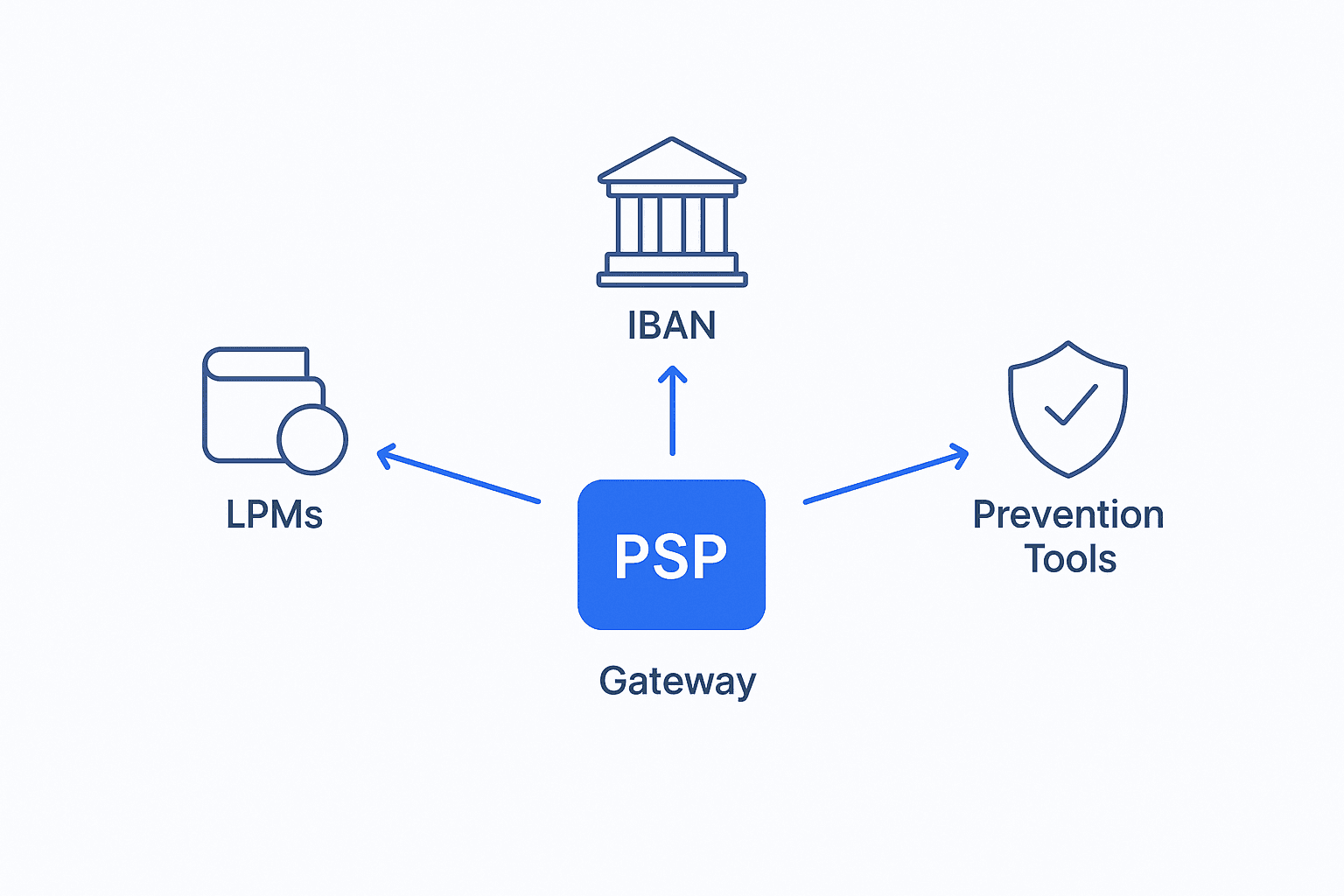
A payment service provider (PSP) is a company that lets businesses accept payments, by card, bank transfer, wallet or local payment method, without building their own connections to banks and card schemes. For most online merchants, the PSP is the company they actually sign up with.
The term is used loosely, though. In EU law it has a precise meaning, and in everyday payments it covers several different business models. This guide explains what a PSP is, how it differs from an acquirer, a payment facilitator and an ISO, what services PSPs offer, and how to choose one.
Key takeaways
- A PSP gives merchants access to payment acceptance through one contract and one integration, usually including a payment gateway, acquiring and reporting.
- In the EU, “payment service provider” is a legal term for licensed firms: banks, e-money institutions and payment institutions. Companies that only provide technology, without holding customer funds, are technical service providers.
- The acquirer is the licensed institution that settles card payments to the merchant. Some PSPs are acquirers themselves; others work with partner acquirers.
- Payment facilitators and ISOs are other models: a payment facilitator signs merchants up under its own acquiring relationship, while an ISO refers merchants to an acquirer.
- Check who holds your funds, who the acquirer is, and whether the provider works with your industry before you sign.
What is a payment service provider?
In everyday use, a payment service provider is any company that helps merchants accept and manage payments: online, in apps or at the point of sale. A typical PSP bundles the pieces a merchant needs:
- a payment gateway to capture payment details at checkout;
- access to acquiring, so card payments can be accepted and settled;
- local payment methods and wallets;
- fraud screening, reporting and settlement.
Instead of signing separate contracts with a bank, a gateway and each payment method, the merchant signs one contract and builds one integration.
What “payment service provider” means in EU law
Under the EU’s second Payment Services Directive (PSD2), “payment service provider” has a legal meaning. It covers credit institutions (banks), electronic money institutions, payment institutions and a few public bodies. All of these are authorised and supervised. A payment institution licence is what most non-bank payment companies in the EU hold.
PSD2 also describes technical service providers: companies that support payment services with technology but never take possession of the funds. Many companies that call themselves PSPs commercially are in this category, providing the gateway and integration while a licensed partner handles the money.
For a merchant, the practical question is simple: who holds my money between the customer paying and me being paid, and are they authorised to do so? The UK has its own regime with the same idea, supervised by the FCA.
PSP vs acquirer vs payment facilitator vs ISO
| Model | What it does | Who holds the merchant relationship |
|---|---|---|
| Acquirer | A licensed institution that is a member of the card schemes. It processes card payments for merchants and settles the funds to them. | The acquirer, which opens the merchant account and carries the scheme liability. |
| Payment service provider | Bundles gateway, acquiring access, payment methods and tools into one service. May be an acquirer itself, or work with one or more partner acquirers. | The PSP, sometimes alongside the acquirer, which may also contract with the merchant. |
| Payment facilitator (PayFac) | Registered with the card schemes through a sponsoring acquirer. It signs up many small “sub-merchants” under its own acquiring relationship, so they can start quickly. | The payment facilitator, which onboards and monitors its sub-merchants. |
| ISO (independent sales organisation) | A registered agent that finds and refers merchants to an acquirer, often adding its own service and pricing. | The acquirer holds the merchant account; the ISO manages the relationship. |
The names overlap in practice, and one company can play several roles. What matters is knowing which acquirer processes your payments, who is liable to the card schemes, and who you call when something goes wrong.
How a PSP works
- Capture: the customer pays through the PSP’s checkout, hosted payment page, plugin, app SDK or terminal. Card data is protected under PCI DSS.
- Screening and authentication: the PSP runs fraud checks and, where required, 3D Secure.
- Authorisation: the payment goes to the acquirer, through the card scheme, to the customer’s bank, which approves or declines it.
- Clearing and settlement: approved payments are settled to the acquirer and then paid out to the merchant, net of fees and any rolling reserve.
- Reporting: the PSP gives the merchant transaction, settlement, refund and chargeback data.
A PSP with several acquirers can also route payments between them. When that routing becomes a dedicated layer across several providers, it is called payment orchestration.
What services do PSPs offer?
- Card acceptance: Visa, Mastercard and often other schemes, online and in person.
- Local payment methods: such as iDEAL, Bancontact and MobilePay. See our guide to local payment methods in Europe.
- Recurring billing: stored credentials and scheduled charges for subscriptions. More in our guide to recurring billing.
- Tokenisation: replacing card numbers with tokens so they can be stored safely. See tokenisation.
- Multi-currency processing: pricing and settling in more than one currency. See multi-currency payment processing.
- Fraud and dispute tools: screening rules, 3D Secure and access to pre-dispute services.
- Payouts: some PSPs also send money out, for example to affiliates, creators or sellers.
- Reporting and reconciliation: dashboards and settlement files for finance teams.
PSPs for high-risk merchants
Many mainstream PSPs don’t accept businesses in adult, gambling, dating, nutraceuticals or other high-risk industries, or close their accounts once they notice. A PSP that works with high-risk merchants needs acquirers that accept your merchant category, can handle card scheme registration, and understands the dispute levels in your industry. That usually means more detailed onboarding, higher fees and a reserve, but a more stable account. See our guide to high-risk merchant accounts.
How to choose a PSP
- Authorisation: check who holds your funds and that they are authorised in your market.
- Acquirer: ask which acquirer processes your payments, and in which country.
- Industry fit: make sure the PSP and its acquirers accept your business model and MCC.
- Payment methods: check that the methods your customers use in each market are available for your business type.
- Fees and reserves: get the full fee schedule and the reserve terms in writing.
- Integration: check plugins for your platform, the hosted page options and the API.
- Support: find out who your contact is and how quickly they respond.
Frequently asked questions
What is a payment service provider?
A payment service provider is a company that lets businesses accept payments by card, bank transfer, wallet or local payment method through one contract and integration. It usually provides a payment gateway, access to acquiring, fraud tools and reporting.
Is a PSP regulated?
In the EU, payment service providers in the legal sense are authorised firms: banks, e-money institutions and payment institutions. Companies that only provide the technology and never hold customer funds are technical service providers. Always check who holds your money.
What is the difference between a PSP and an acquirer?
The acquirer is the licensed card scheme member that settles card payments to the merchant. A PSP bundles acquiring access with a gateway, payment methods and tools. Some PSPs are acquirers themselves; others work with partner acquirers.
What is the difference between a PSP and a payment gateway?
A payment gateway is the technology that captures payment details and sends them for authorisation. A PSP usually includes a gateway, plus acquiring access, payment methods, settlement and reporting.
What is a payment facilitator?
A payment facilitator is registered with the card schemes through a sponsoring acquirer and signs up smaller merchants as sub-merchants under its own acquiring relationship. This makes onboarding fast, but the facilitator controls the account.
Can high-risk businesses use a PSP?
Yes, but they need a PSP whose acquirers accept their industry. Many mainstream PSPs don’t. High-risk PSPs usually have more detailed onboarding, higher fees and a rolling reserve.
Do I need a PSP or a merchant account?
To accept cards you need acquiring, which comes with a merchant account. A PSP can provide that together with the gateway and other tools, or you can contract with an acquirer and gateway separately.
Next step
If you run a high-risk business, choosing a PSP is really choosing an acquirer that will keep your account open. Fasto works with adult, subscription, nutraceutical, gaming, dating and hospitality merchants, and approval typically takes two to three weeks.
Get a free quote and tell us about your business.